Table of Contents
Acne may disappear over time, but for many people, the scars it leaves behind can continue to affect confidence and self-esteem. Acne scars are among the most common reasons patients visit a dermatologist, hoping to achieve smoother, healthier-looking skin. Fortunately, advances in aesthetic dermatology have made it possible to significantly reduce the appearance of acne scars with minimally invasive treatments.
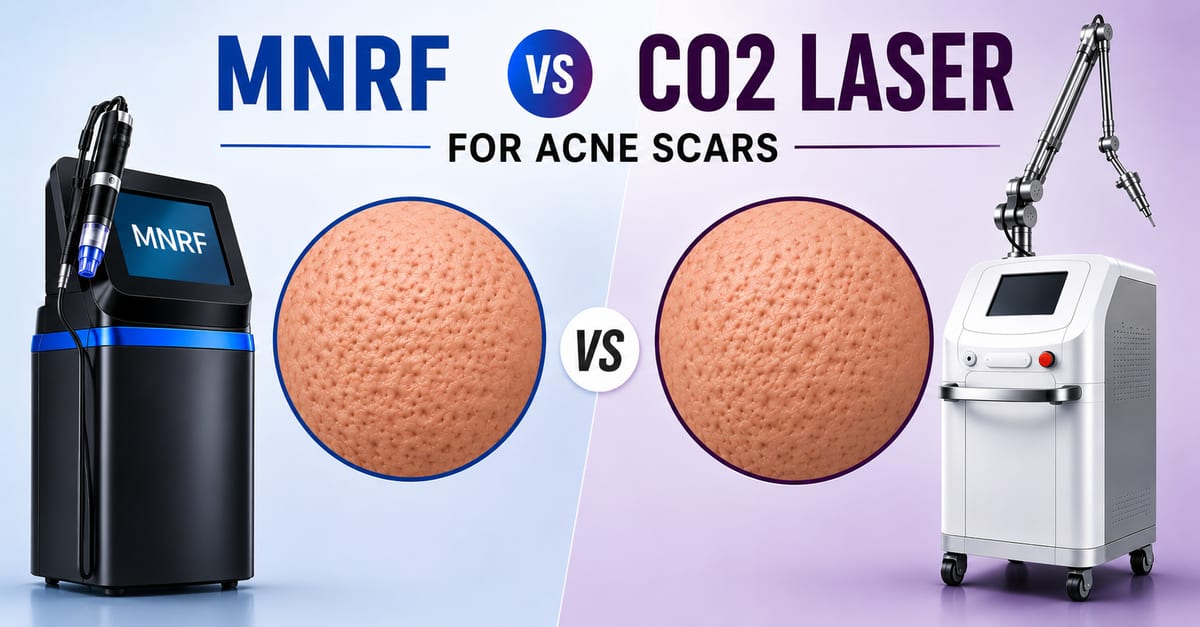
Two of the most effective and widely recommended procedures for acne scar treatment are Microneedling Radiofrequency (MNRF) and Fractional CO₂ Laser Resurfacing. While both treatments stimulate collagen production and improve skin texture, they work in different ways and are suited for different types of scars and skin types.
As an MD Dermatologist, one of the most common questions I hear from patients is, “Doctor, which treatment is better—MNRF or CO₂ Laser?”
The answer isn’t as simple as choosing one over the other. The best treatment depends on several factors, including the type of acne scars, skin tone, downtime expectations, and your overall skin condition.
In this guide, I’ll explain how each treatment works, their benefits, differences, recovery time, and how we decide which option is most suitable for each patient.
Understanding Acne Scars
Before discussing treatment options, it’s important to understand why acne scars develop.
Acne scars form when severe inflammation damages the deeper layers of the skin. During healing, the body produces collagen to repair the damaged tissue. If too little collagen is produced, depressed or atrophic scars develop. If excess collagen forms, raised scars may occur.
The most common types of acne scars include:
Ice Pick Scars
These are narrow, deep scars that extend into the skin and are among the most difficult to treat.
Boxcar Scars
Boxcar scars appear as wider depressions with well-defined edges and are commonly seen on the cheeks.
Rolling Scars
These scars create an uneven, wave-like appearance due to fibrous bands pulling the skin downward.
Post-Acne Pigmentation
Although technically not scars, many patients also experience dark spots or redness after acne heals.
Because each scar behaves differently, treatment should always be individualized rather than following a one-size-fits-all approach.
Why Professional Evaluation Is Important
One of the biggest mistakes patients make is choosing a treatment based solely on social media videos or recommendations from friends.
Two people may have acne scars that appear similar but require completely different treatment plans.
During consultation, I assess:
- The type of acne scars
- Their depth and severity
- Skin thickness
- Skin tone
- Presence of active acne
- Pigmentation risk
- Previous treatments
- Lifestyle factors
Only after this evaluation can we decide whether MNRF, CO₂ Laser, or a combination approach will provide the best results.
What Is MNRF (Microneedling Radiofrequency)?
Microneedling Radiofrequency, commonly called MNRF, combines two proven technologies:
- Microneedling
- Radiofrequency energy
During the procedure, extremely fine insulated needles penetrate the skin to a controlled depth while simultaneously delivering radiofrequency energy into the deeper dermis.
This controlled thermal energy stimulates:
- Collagen production
- Elastin remodeling
- Skin tightening
- Scar remodeling
Unlike traditional microneedling, MNRF works deeper beneath the skin while causing minimal damage to the surface.
Because of this, recovery is generally quicker, and the treatment is considered safer for darker skin tones.
Benefits of MNRF
One reason MNRF has become increasingly popular is its versatility.
It can improve:
- Acne scars
- Enlarged pores
- Fine lines
- Mild skin laxity
- Skin texture
- Oily skin
Patients also appreciate that MNRF involves:
- Minimal downtime
- Reduced risk of pigmentation
- Gradual natural-looking improvement
- Better tolerance in Indian skin types
Collagen production continues for several months after treatment, meaning results improve progressively over time.
What Is Fractional CO₂ Laser?
Fractional CO₂ Laser is one of the most established technologies for skin resurfacing.
Unlike MNRF, which delivers energy beneath the skin, Fractional CO₂ Laser creates microscopic treatment columns by vaporizing tiny portions of damaged skin while leaving surrounding tissue intact.
This process stimulates:
- New collagen formation
- Skin resurfacing
- Scar remodeling
- Improved skin texture
- Smoother complexion
Because the laser treats both the surface and deeper layers of the skin, it often produces dramatic improvement in appropriate candidates.
Benefits of Fractional CO₂ Laser
Fractional CO₂ Laser offers several advantages for selected patients.
It is particularly effective for:
- Moderate to severe acne scars
- Boxcar scars
- Fine wrinkles
- Sun-damaged skin
- Uneven skin texture
Additional benefits include:
- Noticeable skin resurfacing
- Improved skin firmness
- Better skin tone
- Reduction in superficial pigmentation
- Long-term collagen stimulation
However, because the laser affects the skin surface, recovery is usually longer than MNRF.
MNRF vs CO₂ Laser: How Do They Work Differently?
Although both treatments stimulate collagen production, their mechanism of action is quite different.
| Feature | MNRF | Fractional CO₂ Laser |
|---|---|---|
| Energy Source | Radiofrequency | Laser Energy |
| Surface Damage | Minimal | Moderate |
| Collagen Stimulation | Deep Dermis | Surface + Deep Layers |
| Downtime | Short | Longer |
| Risk of Pigmentation | Lower | Slightly Higher in Darker Skin |
| Best for | Acne scars, pores, skin tightening | Deep acne scars, resurfacing, wrinkles |
Neither treatment is universally better.
Each has unique strengths, which is why choosing the correct treatment depends entirely on individual skin assessment.
Which Acne Scars Respond Better to MNRF?
In my clinical experience, MNRF works particularly well for patients who have:
- Rolling scars
- Mild to moderate acne scars
- Enlarged pores
- Early signs of skin aging
- Oily skin
- Mild skin laxity
It is also an excellent option for patients with darker skin tones because it carries a lower risk of post-inflammatory hyperpigmentation compared to ablative laser treatments.
Patients who cannot afford extended downtime often prefer MNRF because redness usually subsides within a few days.
Which Acne Scars Respond Better to CO₂ Laser?
Fractional CO₂ Laser is often recommended for patients with:
- Deep boxcar scars
- Multiple depressed scars
- Sun-damaged skin
- Fine wrinkles
- Significant skin texture irregularities
Because it resurfaces the skin more aggressively, CO₂ Laser can provide greater improvement after fewer sessions in carefully selected patients.
However, it requires proper post-procedure care and sun protection to minimize the risk of pigmentation.
Is One Treatment Better Than the Other?
This is perhaps the most common question patients ask.
The truth is that there is no universally superior treatment.
Instead, the best treatment depends on:
- Your scar type
- Skin colour
- Skin sensitivity
- Downtime expectations
- Lifestyle
- Previous treatments
- Overall skin health
In many cases, the best outcomes are achieved not by choosing one treatment over the other but by combining different technologies as part of a personalized treatment plan.
For example, some patients may benefit from MNRF initially to improve collagen remodeling, followed by Fractional CO₂ Laser for additional skin resurfacing. Others may require adjunctive procedures such as subcision, chemical peels, PRP, or TCA CROSS to target specific scar types.
Recovery After MNRF
One of the biggest advantages of Microneedling Radiofrequency (MNRF) is its relatively short recovery period.
Immediately after the procedure, you may notice mild redness and slight swelling, similar to a mild sunburn. Some patients also experience a feeling of warmth or tightness in the treated area, but these symptoms usually settle within 24 to 72 hours.
Because the skin surface remains largely intact, healing is generally quick, allowing most patients to return to work or their regular activities within a day or two.
During recovery, I usually advise my patients to:
- Keep the skin well moisturized.
- Avoid direct sun exposure.
- Use a broad-spectrum sunscreen (SPF 50 or higher).
- Avoid harsh skincare products for a few days.
- Skip makeup for at least 24 hours.
- Follow the post-treatment skincare routine prescribed by your dermatologist.
As collagen production continues beneath the skin, improvements become more noticeable over the next few weeks and continue for several months.
Recovery After Fractional CO₂ Laser
Recovery after Fractional CO₂ Laser is longer because the treatment intentionally resurfaces the skin.
Immediately after the procedure, patients commonly experience:
- Redness
- Swelling
- Warmth
- Mild discomfort
- Tiny crusts or scabs
The skin begins healing over the next several days. Peeling usually starts around the third or fourth day and gradually settles within a week.
Most patients require about 7–10 days before they feel comfortable returning to social activities, although redness may persist for a few weeks depending on the intensity of the treatment.
Proper aftercare is extremely important.
Following CO₂ Laser treatment, I recommend:
- Strict sun protection
- Frequent moisturization
- Avoiding exfoliants
- Avoiding swimming pools and saunas
- Not picking at peeling skin
- Using only prescribed healing creams
Patience during the healing process is essential, as the skin continues to remodel itself over several months.
How Many Sessions Will You Need?
This is another question I am frequently asked during consultations.
The number of sessions depends on several factors, including:
- The type of acne scars
- Their severity
- Skin quality
- Healing response
- Treatment goals
MNRF
Most patients require approximately 3 to 6 sessions, spaced about 4 to 6 weeks apart, to achieve noticeable improvement.
Since collagen remodeling is gradual, improvements continue even after the final session.
Fractional CO₂ Laser
Patients with moderate acne scars often require 2 to 4 sessions, depending on the depth of the scars and the desired outcome.
Because CO₂ Laser is a more intensive procedure, fewer sessions may be needed compared to MNRF, although recovery between sessions is longer.
It’s important to understand that acne scars cannot usually be erased completely. The goal of treatment is significant improvement in skin texture and appearance rather than perfection.
Are These Treatments Painful?
Both procedures are performed using topical numbing cream, making them well tolerated by most patients.
During MNRF
Patients typically describe the sensation as:
- Mild pricking
- Warmth
- Slight pressure
Discomfort is generally minimal.
During CO₂ Laser
Because the laser treats the skin surface more aggressively, patients may experience greater heat and stinging sensations during the procedure. However, adequate numbing significantly improves comfort.
After treatment, there may be temporary burning or tightness, which usually settles within a few hours to a day.
What Are the Possible Side Effects?
Every medical procedure carries some risks, although complications are uncommon when treatments are performed by an experienced dermatologist.
Possible Side Effects of MNRF
- Temporary redness
- Mild swelling
- Dryness
- Slight bruising
- Temporary sensitivity
These effects usually resolve within a few days.
Possible Side Effects of CO₂ Laser
- Redness lasting several weeks
- Swelling
- Peeling
- Temporary pigmentation changes
- Rare infections
- Delayed healing if aftercare instructions are not followed
Patients with darker skin tones have a slightly higher risk of post-inflammatory hyperpigmentation after CO₂ Laser, which is why careful patient selection and appropriate settings are crucial.
Which Treatment Is Better for Indian Skin?
This is an especially important consideration in India, where many individuals have Fitzpatrick Skin Types IV to V.
These skin types naturally contain more melanin, making them more prone to pigmentation following aggressive procedures.
In many such cases, MNRF is often preferred because it causes minimal damage to the skin surface while effectively stimulating collagen production.
However, this does not mean CO₂ Laser cannot be used safely.
With proper patient selection, experienced technique, skin priming, and post-treatment care, Fractional CO₂ Laser can also produce excellent results in Indian skin.
The key lies in customizing the treatment rather than applying the same protocol to every patient.
Can MNRF and CO₂ Laser Be Combined?
Absolutely.
In fact, combination therapy often provides the best results for patients with complex acne scars.
For example, a patient with rolling scars, boxcar scars, enlarged pores, and uneven skin texture may benefit from:
- Subcision to release tethered scars
- MNRF to stimulate deep collagen remodeling
- Fractional CO₂ Laser to improve surface texture
- TCA CROSS for deep ice-pick scars
- PRP (Platelet-Rich Plasma) to enhance healing and collagen formation
By combining treatments, we can target different layers of the skin and different scar types, often achieving better overall improvement than a single procedure alone.
Factors That Influence Treatment Success
While the technology used is important, the outcome depends on several additional factors:
Accurate Diagnosis
Not all scars respond to the same treatment.
Skin Type
Darker skin requires careful planning to reduce pigmentation risk.
Scar Severity
Deeper scars often need combination therapies.
Post-Treatment Care
Following aftercare instructions plays a major role in healing and final results.
Lifestyle Factors
Smoking, poor nutrition, inadequate sleep, and excessive sun exposure can slow collagen production and delay improvement.
MNRF vs CO₂ Laser: A Quick Comparison
| Feature | MNRF | Fractional CO₂ Laser |
|---|---|---|
| Best for | Mild to Moderate Acne Scars | Moderate to Severe Acne Scars |
| Downtime | 1–3 Days | 7–10 Days |
| Surface Damage | Minimal | Moderate |
| Collagen Stimulation | Excellent | Excellent |
| Skin Tightening | Yes | Moderate |
| Risk of Pigmentation | Lower | Slightly Higher |
| Suitable for Indian Skin | Excellent | Good with Expert Care |
| Number of Sessions | 3–6 | 2–4 |
Frequently Asked Questions
Can acne scars be removed completely?
Complete removal is rarely possible. However, modern dermatological treatments can significantly improve the appearance of scars, often by 60–90%, depending on the scar type and severity.
Which treatment gives faster results?
Fractional CO₂ Laser may provide more noticeable improvement after fewer sessions, but it also involves longer recovery.
MNRF produces gradual improvement with shorter downtime.
Is MNRF safer than CO₂ Laser?
Both treatments are considered safe when performed by an experienced MD Dermatologist. The choice depends on your skin type, scar pattern, and treatment goals.
Can active acne be treated with these procedures?
No. Active acne should first be brought under control before beginning scar treatment. Treating scars while acne is still active can lead to new scar formation.
What age is suitable for acne scar treatment?
Treatment can usually begin once active acne has settled and the skin has healed adequately. There is no strict age limit, but an individual assessment is essential.
My Approach to Treating Acne Scars
As a dermatologist, I believe that successful acne scar treatment is never about choosing the latest machine or following trends. It begins with understanding the patient’s skin, identifying the type of scars, and creating a personalized treatment plan.
No single treatment is ideal for every individual. Some patients achieve excellent results with MNRF alone, while others may benefit more from Fractional CO₂ Laser or a combination of therapies.
During every consultation, my goal is to recommend treatments based on medical evidence, clinical experience, and the patient’s unique skin concerns—not on a one-size-fits-all approach.
Final Thoughts
Both Microneedling Radiofrequency (MNRF) and Fractional CO₂ Laser are highly effective treatments for acne scars, but they are not interchangeable. Each has its own strengths, advantages, and ideal indications.
MNRF is an excellent option for patients seeking collagen stimulation with minimal downtime and is particularly suitable for Indian skin types. Fractional CO₂ Laser remains one of the most effective resurfacing treatments for deeper acne scars and significant textural irregularities.
The most important decision isn’t choosing between MNRF and CO₂ Laser—it’s choosing a qualified MD Dermatologist who can accurately assess your skin and recommend the right treatment for your specific needs.
If you are considering acne scar treatment, remember that realistic expectations, individualized care, and consistent follow-up are the keys to achieving smoother, healthier-looking skin.
Reference Sources
- American Academy of Dermatology (AAD) – Acne Scars: Diagnosis and Treatment
https://www.aad.org/public/diseases/acne/derm-treat/scars - American Society for Dermatologic Surgery (ASDS) – Laser Skin Resurfacing
https://www.asds.net/skin-experts/skin-treatments/laser-skin-resurfacing - Mayo Clinic – Acne: Symptoms and Causes
https://www.mayoclinic.org/diseases-conditions/acne/symptoms-causes/syc-20368047 - National Center for Biotechnology Information (NCBI) – Microneedling in Acne Scar Treatment: A Systematic Review
https://www.ncbi.nlm.nih.gov/pmc/articles/PMC4976400/ - National Center for Biotechnology Information (NCBI) – Fractional CO₂ Laser for Atrophic Acne Scars
https://www.ncbi.nlm.nih.gov/pmc/articles/PMC3583892/