Table of Contents
One of the most common misconceptions I hear in my practice is that skin boosters and dermal fillers are the same treatment. Many patients walk into my clinic believing that both involve injections of hyaluronic acid, so they must deliver the same results. Others worry that skin boosters will make their face look “filled” or “puffy” like fillers.
The truth is quite different.
Although both treatments are injectable aesthetic procedures and may contain hyaluronic acid, they are designed for completely different purposes. Skin boosters are intended to improve skin quality, hydration, elasticity, and radiance, while dermal fillers are primarily used to restore lost volume, enhance facial contours, and reduce deeper wrinkles.
As an MD Dermatologist, I always tell my patients that choosing between skin boosters and dermal fillers is not about deciding which treatment is better—it is about understanding which treatment addresses your specific concerns.
In this article, I’ll explain the differences between these two popular treatments, how they work, who they are suitable for, and how we determine the right option for each patient.
Understanding Facial Aging
Before discussing treatments, it’s important to understand why our skin changes with age.
As we grow older, our skin naturally loses:
- Collagen
- Elastin
- Hyaluronic acid
- Fat volume
- Moisture
These changes lead to:
- Fine lines
- Wrinkles
- Dull skin
- Dryness
- Reduced elasticity
- Hollow cheeks
- Under-eye volume loss
- Sagging
Different signs of aging require different treatment approaches.
Some patients mainly need hydration and collagen stimulation.
Others require structural support and volume restoration.
This is where understanding the difference between skin boosters and dermal fillers becomes important.
What Are Skin Boosters?
Skin boosters are injectable treatments designed to improve the overall quality of the skin rather than changing facial shape or adding volume.
Most skin boosters contain a soft, highly purified form of hyaluronic acid that spreads evenly beneath the skin.
Instead of filling specific areas, they work by deeply hydrating the skin from within while stimulating collagen production.
Unlike creams or serums that only act on the surface, skin boosters deliver hydration directly into the deeper layers of the skin.
This results in gradual improvement in:
- Skin hydration
- Skin texture
- Elasticity
- Smoothness
- Glow
- Fine lines
Patients often describe the result as looking healthier, fresher, and naturally radiant rather than looking “treated.”
How Do Skin Boosters Work?
Hyaluronic acid has an incredible ability to attract and retain water.
When injected into the skin, skin boosters improve moisture retention while encouraging the skin’s natural repair mechanisms.
Over time, this stimulates collagen remodeling, leading to healthier and firmer skin.
Unlike fillers, skin boosters do not create volume or reshape facial features.
Instead, they improve the condition of the skin itself.
This is why they are sometimes referred to as skin quality treatments rather than volumizing procedures.
Benefits of Skin Boosters
Skin boosters offer several benefits for patients looking to improve overall skin health.
These include:
- Deep hydration
- Better skin texture
- Improved elasticity
- Reduction in fine lines
- Increased skin luminosity
- Healthier-looking skin
- Softer appearance
- Natural rejuvenation
Because the results develop gradually, most people simply notice that your skin looks refreshed without being able to identify why.
Who Is an Ideal Candidate for Skin Boosters?
Skin boosters are suitable for individuals who experience:
- Dry or dehydrated skin
- Early signs of aging
- Fine lines
- Dull complexion
- Loss of skin elasticity
- Uneven skin texture
They are also popular among younger patients who wish to maintain healthy skin before significant aging develops.
Skin boosters can be used on:
- Face
- Neck
- Hands
- Décolletage
making them an excellent option for overall skin rejuvenation.
What Are Dermal Fillers?
Dermal fillers are injectable gels designed to restore facial volume, improve contours, and soften deeper wrinkles.
Unlike skin boosters, fillers are thicker and more structured.
They are carefully placed beneath the skin to provide support where volume has been lost.
As we age, fat pads beneath the skin gradually shrink, leading to hollow cheeks, sunken temples, under-eye depressions, and loss of jawline definition.
Dermal fillers help restore these structural changes.
How Do Dermal Fillers Work?
Most modern dermal fillers are made from cross-linked hyaluronic acid.
Cross-linking makes the hyaluronic acid firmer and longer-lasting than that used in skin boosters.
Rather than spreading throughout the skin, fillers remain in specific areas where they are injected.
This allows them to:
- Restore lost volume
- Lift facial tissues
- Improve contours
- Smooth deep folds
- Enhance facial proportions
Because fillers provide structural support, results are usually visible immediately after treatment.
Common Areas Treated with Dermal Fillers
Dermal fillers can improve several facial areas, including:
- Cheeks
- Lips
- Chin
- Jawline
- Under-eye hollows
- Nasolabial folds
- Marionette lines
- Temples
Each area requires careful assessment to ensure balanced and natural-looking results.
Benefits of Dermal Fillers
Dermal fillers offer several advantages for patients experiencing facial volume loss.
Benefits include:
- Immediate improvement
- Restored facial volume
- Enhanced facial contours
- Softer deep wrinkles
- Improved facial symmetry
- More youthful appearance
When performed conservatively by an experienced dermatologist, fillers should enhance your natural features rather than change the way you look.
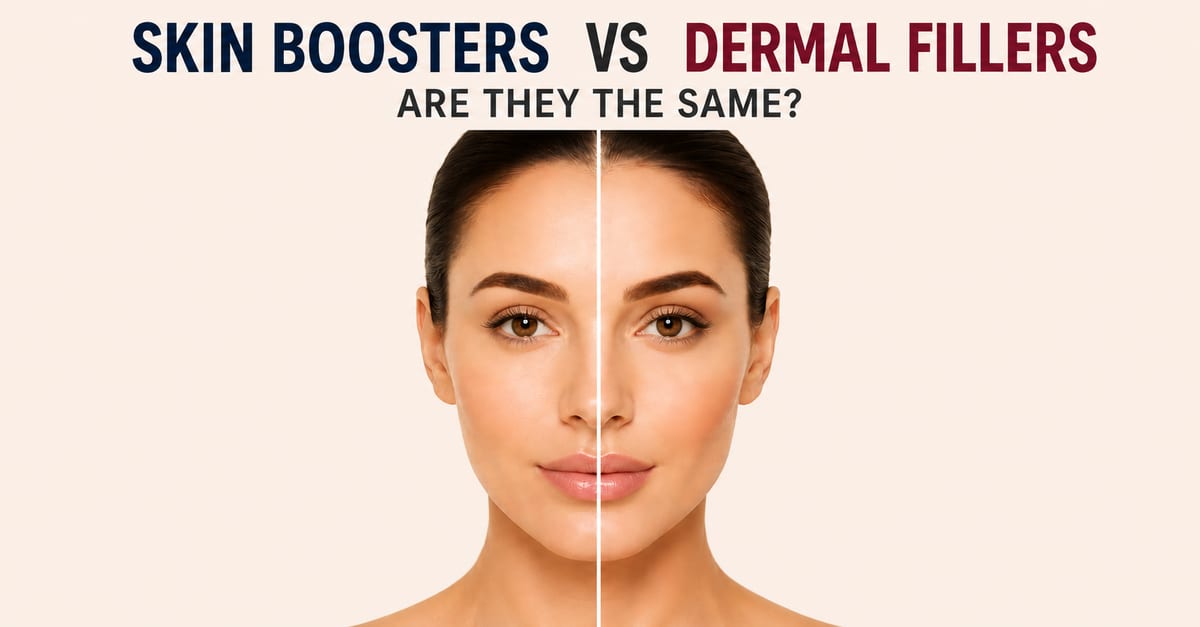
Skin Boosters vs Dermal Fillers: What Is the Main Difference?
Although both treatments may contain hyaluronic acid, their purpose is completely different.
Think of it this way:
Skin boosters improve the quality of your skin.
Dermal fillers improve the shape and structure of your face.
One focuses on healthier skin.
The other focuses on restoring lost facial volume.
This distinction is important because many patients expect skin boosters to lift sagging cheeks or fillers to improve dull skin.
In reality, each treatment has a specific role.
Comparison Table: Skin Boosters vs Dermal Fillers
| Feature | Skin Boosters | Dermal Fillers |
|---|---|---|
| Primary Goal | Improve skin quality | Restore facial volume |
| Main Benefit | Hydration & Glow | Contouring & Lifting |
| Hyaluronic Acid | Soft, spreadable | Cross-linked, structured |
| Results | Gradual | Immediate |
| Volume Enhancement | No | Yes |
| Skin Texture Improvement | Excellent | Minimal |
| Fine Lines | Yes | Moderate |
| Deep Wrinkles | Limited | Excellent |
| Facial Contouring | No | Yes |
| Downtime | Minimal | Minimal |
Which Skin Concerns Do Skin Boosters Treat?
Skin boosters are best suited for improving:
- Dehydrated skin
- Dull complexion
- Fine lines
- Rough texture
- Loss of elasticity
- Early aging changes
Patients often choose skin boosters before weddings, important events, or as part of a long-term skin maintenance plan.
Which Concerns Are Better Treated with Dermal Fillers?
Dermal fillers are recommended for patients experiencing:
- Hollow cheeks
- Thin lips
- Under-eye hollows
- Jawline definition loss
- Chin enhancement
- Deep smile lines
- Marionette lines
- Facial asymmetry
Because fillers restore lost support beneath the skin, they are particularly effective for age-related volume loss.
Can Skin Boosters Replace Dermal Fillers?
No.
This is one of the biggest myths in aesthetic dermatology.
Skin boosters cannot replace dermal fillers because they do not create volume.
Similarly, dermal fillers cannot replace skin boosters because they do not significantly improve overall skin hydration or texture.
Each treatment serves a different purpose, and selecting the right one depends entirely on your individual concerns.
How Long Do Skin Boosters and Dermal Fillers Last?
One of the first questions patients ask during their consultation is, “How long will the results last?”
The answer depends on several factors, including the type of product used, your metabolism, lifestyle habits, age, and skincare routine.
Skin Boosters
Skin boosters work by improving skin hydration and stimulating collagen production. Since they focus on enhancing skin quality rather than adding volume, their results develop gradually.
Typically:
- Initial treatment consists of 2–3 sessions spaced about 3–4 weeks apart.
- Results become noticeable within a few weeks after the first session.
- Improvement continues as collagen production increases.
- Results generally last 6–9 months, after which maintenance sessions may be recommended.
Patients often notice that their skin feels smoother, appears brighter, and retains moisture much better.
Dermal Fillers
Dermal fillers provide immediate structural support to the face.
The longevity of fillers depends on:
- Treatment area
- Type of filler used
- Facial movements
- Individual metabolism
On average:
- Lip fillers may last 6–12 months.
- Cheek fillers often last 12–18 months.
- Chin and jawline fillers may last 12–24 months.
Although fillers are temporary, they gradually dissolve naturally over time.
Which Treatment Gives More Natural Results?
Many patients worry that injectable treatments may leave them looking unnatural.
The truth is that natural-looking results depend far more on the injector’s expertise than the treatment itself.
When performed correctly:
Skin Boosters
Patients usually hear comments like:
- “Your skin looks so healthy.”
- “You look fresh.”
- “Have you changed your skincare routine?”
Most people won’t realize you’ve had a cosmetic procedure because skin boosters enhance skin quality without changing facial shape.
Dermal Fillers
Modern dermal fillers are designed to restore youthful proportions—not create an exaggerated appearance.
The goal is to:
- Restore lost volume.
- Maintain facial harmony.
- Preserve natural facial expressions.
An experienced dermatologist understands facial anatomy and uses fillers conservatively to achieve subtle, balanced results.
Are Skin Boosters and Dermal Fillers Safe?
Both procedures have an excellent safety profile when performed by a qualified MD Dermatologist using approved products.
Before recommending any injectable treatment, I carefully evaluate:
- Medical history
- Current medications
- Previous cosmetic treatments
- Pregnancy or breastfeeding status
- Skin health
- Facial anatomy
This assessment helps determine whether the treatment is appropriate and minimizes potential risks.
What Are the Possible Side Effects?
Like any medical procedure, injectable treatments may cause temporary side effects.
Fortunately, these are usually mild and short-lived.
Skin Boosters
Patients may experience:
- Mild redness
- Tiny injection marks
- Temporary swelling
- Mild tenderness
- Occasional bruising
These effects usually settle within 24–72 hours.
Dermal Fillers
Possible temporary side effects include:
- Mild swelling
- Bruising
- Tenderness
- Temporary firmness
- Slight asymmetry during the initial healing phase
These effects generally improve within a few days.
Serious complications are uncommon but highlight the importance of choosing a qualified dermatologist who understands facial anatomy and follows strict safety protocols.
Recovery After Treatment
One advantage of both treatments is minimal downtime.
After Skin Boosters
Patients can usually return to work the same day or the following day.
For the first 24 hours, I recommend:
- Avoid strenuous exercise.
- Avoid makeup for several hours.
- Stay hydrated.
- Avoid excessive heat and sauna exposure.
- Use sunscreen regularly.
After Dermal Fillers
Recovery is also relatively quick.
Patients should:
- Avoid vigorous exercise for 24 hours.
- Avoid alcohol immediately after treatment.
- Sleep with the head slightly elevated if swelling occurs.
- Avoid excessive pressure on treated areas.
- Follow the post-treatment instructions provided by the dermatologist.
Most swelling subsides within a few days.
Can Skin Boosters and Dermal Fillers Be Combined?
Absolutely.
In fact, combination treatments often provide the most comprehensive facial rejuvenation.
Think of facial aging as involving two separate problems:
Problem One: Declining skin quality.
Problem Two: Loss of facial volume.
Skin boosters improve the skin itself.
Dermal fillers restore structural support.
When used together, they complement one another beautifully.
For example:
A patient in their forties may have:
- Dull skin
- Fine lines
- Hollow cheeks
Using fillers alone may restore cheek volume but won’t improve overall skin quality.
Similarly, skin boosters alone won’t restore lost facial contours.
Combining both treatments allows us to address multiple concerns simultaneously while maintaining a natural appearance.
How Do I Decide Which Treatment Is Right for My Patients?
Every patient is unique.
Rather than recommending the same procedure for everyone, I evaluate several factors during consultation.
These include:
- Age
- Skin quality
- Facial volume
- Lifestyle
- Medical history
- Aesthetic goals
- Previous cosmetic procedures
For example:
A 28-year-old patient with dehydrated skin may benefit primarily from skin boosters.
A 48-year-old patient experiencing cheek volume loss may achieve better results with dermal fillers.
Some patients require a combination approach.
The treatment plan is always individualized.
Common Myths About Skin Boosters and Dermal Fillers
Myth 1: They Are the Same Treatment
False.
Although both may contain hyaluronic acid, they are designed for entirely different purposes.
Myth 2: Fillers Always Look Fake
False.
When performed correctly, fillers simply restore youthful proportions without creating an artificial appearance.
Myth 3: Skin Boosters Add Facial Volume
False.
Skin boosters improve hydration and skin quality but do not reshape the face.
Myth 4: Only Older People Need These Treatments
False.
Many younger patients choose skin boosters to maintain healthy skin and delay early signs of aging.
Preventive aesthetic treatments are becoming increasingly popular.
Frequently Asked Questions
Can skin boosters replace my skincare routine?
No.
Healthy skincare remains essential.
Skin boosters complement—not replace—a good skincare routine.
Are dermal fillers permanent?
No.
Modern hyaluronic acid fillers gradually dissolve over time.
Which treatment is less painful?
Both procedures are performed after applying topical numbing cream and are generally well tolerated.
Can men undergo these treatments?
Absolutely.
Both skin boosters and dermal fillers are increasingly popular among men seeking healthier skin and subtle facial rejuvenation.
At what age should I start?
There is no ideal age.
Treatment depends on your skin condition rather than your age.
Some patients benefit from preventive skin boosters in their late twenties, while others seek fillers later to address age-related volume loss.
My Approach to Facial Rejuvenation
As a dermatologist, my philosophy is simple.
Cosmetic treatments should enhance your natural beauty—not change your identity.
Whether I recommend skin boosters, dermal fillers, or a combination of both, my objective is always the same:
- Healthy-looking skin
- Balanced facial proportions
- Natural results
- Long-term patient satisfaction
Every face is unique, and every treatment plan should reflect that individuality.
Final Thoughts
Although skin boosters and dermal fillers are both injectable treatments, they are far from identical.
Skin boosters focus on improving hydration, elasticity, and overall skin quality, making them an excellent option for patients seeking fresher, healthier-looking skin.
Dermal fillers, on the other hand, restore lost facial volume, improve contours, and soften deeper wrinkles to create a naturally youthful appearance.
Rather than asking which treatment is better, the more important question is: Which treatment is right for your skin and your concerns?
The answer can only be determined through a detailed consultation with an experienced MD Dermatologist who understands facial anatomy, aging patterns, and individualized treatment planning.
With the right approach, both skin boosters and dermal fillers can deliver beautiful, subtle, and long-lasting results that enhance your confidence while preserving your natural appearance.
Reference Sources
- American Society for Dermatologic Surgery (ASDS) – Dermal Fillers
https://www.asds.net/skin-experts/skin-treatments/dermal-fillers - American Academy of Dermatology (AAD) – Soft Tissue Fillers
https://www.aad.org/public/cosmetic/wrinkles/fillers - Mayo Clinic – Wrinkles: Diagnosis and Treatment
https://www.mayoclinic.org/diseases-conditions/wrinkles/diagnosis-treatment/drc-20354933 - National Center for Biotechnology Information (NCBI) – Hyaluronic Acid in Skin Rejuvenation
https://www.ncbi.nlm.nih.gov/pmc/articles/PMC3583886/ - British College of Aesthetic Medicine (BCAM) – Dermal Fillers and Facial Rejuvenation
https://www.bcam.ac.uk/ - National Center for Biotechnology Information (NCBI) – Injectable Hyaluronic Acid: Safety and Clinical Applications
https://www.ncbi.nlm.nih.gov/pmc/articles/PMC4489976/ - International Society of Aesthetic Plastic Surgery (ISAPS) – Patient Safety in Injectable Treatments
https://www.isaps.org/