Table of Contents
One of the most common concerns I hear from patients in their late 30s, 40s, and 50s is, “Doctor, my face looks tired and saggy. Is there a way to lift my skin without surgery?”
The good news is that advancements in aesthetic medicine have made it possible to achieve noticeable skin tightening and facial rejuvenation without undergoing a surgical facelift. Among the most effective non-invasive treatments available today is HIFU (High-Intensity Focused Ultrasound).
At Derma Solutions Skin & Hair Clinic, Bangalore, HIFU has become a popular choice for patients who want firmer skin, better jawline definition, and a more youthful appearance without incisions, scars, or downtime. While HIFU is often referred to as a “non-surgical facelift,” many patients wonder whether it can truly tighten sagging skin and how its results compare to surgery.
In this article, I will explain how HIFU works, who can benefit from it, what results you can realistically expect, and why it has become one of the most sought-after skin tightening treatments worldwide.
Understanding Why Skin Starts to Sag
Before discussing HIFU, it is important to understand what causes skin laxity in the first place.
Our skin remains firm and youthful because of collagen and elastin, two structural proteins that provide support and elasticity. Unfortunately, collagen production naturally decreases with age. By our 30s, collagen levels begin to decline, and this process accelerates over time.
Several factors contribute to sagging skin:
- Natural aging
- Sun damage
- Weight fluctuations
- Loss of facial fat volume
- Smoking
- Stress
- Poor lifestyle habits
- Genetic factors
As collagen levels reduce, patients may begin noticing:
- Loose skin around the jawline
- Mild jowls
- Drooping cheeks
- Neck laxity
- Deepening smile lines
- Fine lines and wrinkles
- Reduced facial definition
While surgery remains the gold standard for severe skin sagging, many patients today seek less invasive alternatives that fit into their busy lifestyles.
This is where HIFU offers an excellent solution.
What is HIFU?
HIFU stands for High-Intensity Focused Ultrasound.
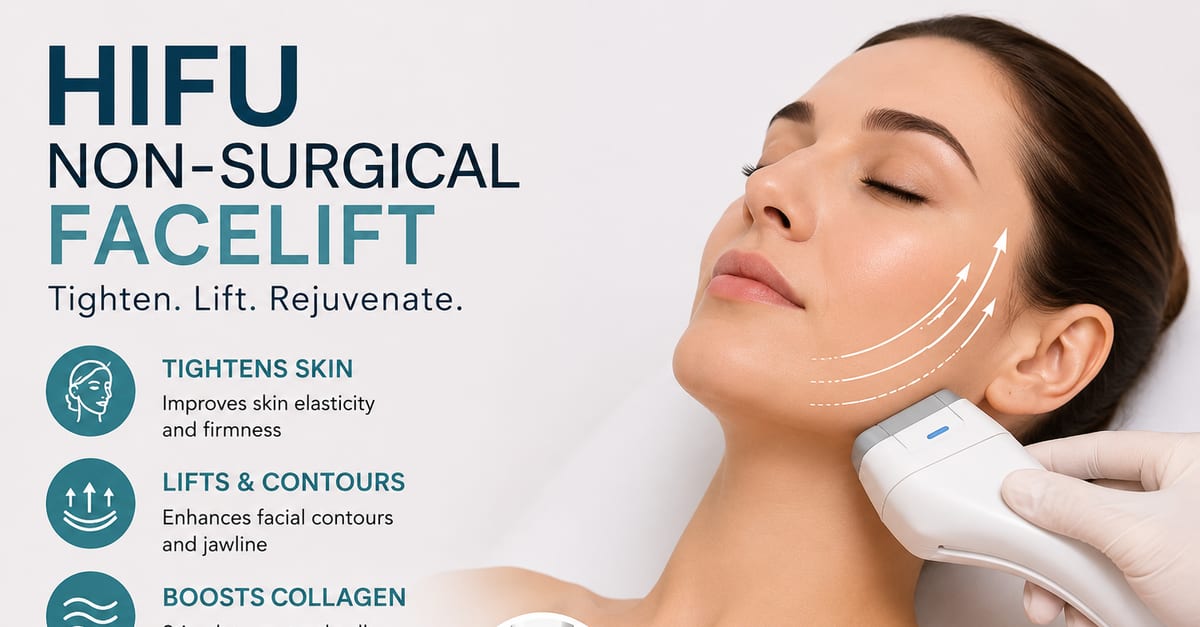
It is an advanced, non-surgical skin tightening treatment that uses focused ultrasound energy to stimulate collagen production deep within the skin.
Unlike lasers or chemical peels that primarily work on the skin’s surface, HIFU targets deeper structural layers responsible for skin support.
One of the reasons HIFU has gained significant popularity is because it can reach the SMAS (Superficial Musculoaponeurotic System) layer. This is the same layer that plastic surgeons tighten during a surgical facelift.
The difference is that HIFU achieves this without:
- Cuts
- Stitches
- General anesthesia
- Hospitalization
- Extended recovery periods
The treatment works by encouraging your body to naturally produce new collagen, resulting in gradual lifting and tightening over time.
How Does HIFU Tighten Sagging Skin?
Many patients assume that skin tightening treatments simply heat the skin surface. HIFU works differently.
The technology delivers highly focused ultrasound energy at precise depths beneath the skin.
These energy points create controlled thermal zones that stimulate the body’s natural healing response.
As a result:
Existing Collagen Contracts
The heat generated by HIFU causes immediate contraction of collagen fibers, creating an initial tightening effect.
New Collagen is Produced
The body responds by generating fresh collagen and elastin over the following weeks and months.
Skin Becomes Firmer
As collagen levels increase, skin gradually becomes tighter, smoother, and more elastic.
Facial Contours Improve
The deeper support structures become stronger, resulting in subtle lifting of the cheeks, jawline, neck, and brows.
The beauty of HIFU lies in the fact that it uses the body’s own regenerative processes to create natural-looking results.
Can HIFU Really Deliver a Non-Surgical Facelift?
This is perhaps the most frequently asked question during consultations.
My answer is simple: Yes, HIFU can provide a noticeable lifting effect and is one of the closest non-surgical alternatives to a facelift available today.
However, patients must have realistic expectations.
A surgical facelift physically removes excess skin and repositions underlying tissues. HIFU does not remove skin.
Instead, it stimulates collagen production and tightens existing tissues.
For patients with mild to moderate skin laxity, the improvement can be significant.
You may notice:
- A sharper jawline
- Reduced jowls
- Better cheek definition
- Lifted eyebrows
- Tighter neck contours
- Firmer skin texture
Many of my patients report that they look fresher, more youthful, and less tired without appearing “done” or artificial.
Areas That Can Be Treated with HIFU
One of the advantages of HIFU is its versatility.
Forehead and Brow Area
As collagen decreases, the eyebrows can begin to droop, making the eyes appear smaller and tired.
HIFU can help:
- Lift the brows
- Open up the eye area
- Improve forehead firmness
Cheeks
Loss of collagen often leads to flattening and sagging of the cheeks.
HIFU helps improve:
- Mid-face support
- Facial contours
- Overall firmness
Jawline
The jawline is one of the most commonly treated areas.
Patients often seek HIFU to:
- Improve jawline definition
- Reduce mild jowls
- Create a slimmer facial profile
Neck
Neck aging is often difficult to treat without surgery.
HIFU can improve:
- Loose neck skin
- Horizontal neck lines
- Early “turkey neck” appearance
Double Chin Area
For suitable candidates, HIFU can improve skin laxity under the chin and enhance overall facial definition.
Who is the Ideal Candidate for HIFU?
In my clinical experience, HIFU works best for patients with early to moderate signs of aging.
Ideal candidates include individuals who:
- Are between 30 and 60 years old
- Have mild to moderate skin laxity
- Notice early sagging around the jawline
- Want to avoid surgery
- Prefer minimal downtime
- Have realistic expectations
Patients who begin HIFU treatments before severe skin laxity develops often achieve the most satisfying outcomes
Who May Need Other Treatments Instead?
While HIFU is highly effective, it is not suitable for every patient.
Individuals with:
- Severe skin sagging
- Significant excess skin
- Advanced jowling
- Very thin skin with substantial volume loss
may require alternative or combination treatments.
During a consultation at Derma Solutions, we carefully assess your skin quality, facial structure, and aesthetic goals before recommending a treatment plan.
Sometimes, combining HIFU with other advanced procedures can provide superior results.
What Happens During a HIFU Session?
Many first-time patients are pleasantly surprised by how straightforward the procedure is.
Consultation and Assessment
We begin by evaluating:
- Skin laxity
- Facial anatomy
- Treatment goals
- Medical history
Treatment Preparation
The skin is cleansed thoroughly before treatment.
Ultrasound Energy Delivery
Using a specialized HIFU handpiece, focused ultrasound energy is delivered to targeted areas at specific depths.
Patients may experience:
- Mild warmth
- Tingling sensations
- Brief prickling feelings
These sensations indicate that collagen stimulation is taking place.
Treatment Duration
Depending on the treatment area, sessions typically take:
- 30–45 minutes for the face
- 60–90 minutes for face and neck
Most patients return to work or daily activities immediately afterward.
When Will You See Results?
One of the most important things I explain to patients is that HIFU results develop gradually.
Unlike fillers, which provide immediate volume, HIFU stimulates a biological process that takes time.
Immediately After Treatment
Some patients notice:
- Mild tightening
- Slight improvement in firmness
After 4 to 8 Weeks
Collagen production begins increasing.
Skin often appears:
- Firmer
- Smoother
- More refreshed
After 2 to 6 Months
This is when the most noticeable lifting and tightening effects become visible.
Patients typically see:
- Improved jawline contours
- Reduced sagging
- Better skin elasticity
- Enhanced facial definition
The gradual nature of the results is one reason why HIFU appears so natural.
How Long Do HIFU Results Last?
Results vary depending on:
- Age
- Skin quality
- Lifestyle habits
- Sun exposure
- Genetics
Most patients enjoy visible improvements for approximately 12 to 18 months.
Many choose annual maintenance sessions to sustain collagen production and prolong their results.
Is HIFU Safe?
Yes.
HIFU has been extensively studied and used globally for aesthetic skin tightening.
When performed by trained professionals using high-quality technology, HIFU is considered very safe.
At Derma Solutions, patient safety is always our priority. Every treatment is customized according to the individual’s skin condition and goals.
Possible temporary side effects may include:
- Mild redness
- Slight swelling
- Tenderness
- Temporary tingling
These effects typically resolve within a few hours to a few days.
HIFU vs Surgical Facelift: What Should You Choose?
This depends entirely on your degree of skin laxity and treatment goals.
A surgical facelift may be more suitable for patients with severe sagging and excess skin.
However, if your goal is to:
- Improve early signs of aging
- Tighten loose skin
- Enhance jawline definition
- Avoid surgery
- Avoid scars
- Minimize downtime
then HIFU can be an excellent option.
Many patients appreciate that they can undergo treatment during a lunch break and return to their normal routine immediately afterward.
Can HIFU Be Combined with Other Treatments?
Absolutely.
At Derma Solutions, combination treatments often provide the most comprehensive rejuvenation.
Depending on your concerns, HIFU may be combined with:
- Radiofrequency skin tightening
- Microneedling
- PRP therapy
- Skin boosters
- Laser treatments
- Anti-aging injectables
A personalized approach allows us to address skin laxity, texture, pigmentation, and overall skin quality simultaneously.
My Expert Opinion on HIFU
As an aesthetic practitioner, I believe HIFU is one of the most valuable non-surgical anti-aging treatments available today.
The treatment offers a unique combination of:
- Safety
- Convenience
- Minimal downtime
- Natural-looking results
- Long-lasting collagen stimulation
The key is selecting the right patient and setting realistic expectations.
For individuals experiencing mild to moderate skin laxity, HIFU can significantly improve facial contours and skin firmness without surgery.
Conclusion
So, can HIFU tighten sagging skin and deliver a non-surgical facelift?
The answer is yes.
HIFU is a scientifically proven treatment that stimulates deep collagen production, improves skin elasticity, and creates a natural lifting effect. While it cannot replace a surgical facelift in cases of severe skin laxity, it can provide impressive rejuvenation for patients seeking a non-invasive solution.
If you have noticed early signs of facial sagging, loss of jawline definition, or loose skin around the neck, HIFU may be an excellent option for you.
At Derma Solutions Skin & Hair Clinic, Bangalore, we offer advanced HIFU treatments tailored to your unique skin concerns and aesthetic goals. A detailed consultation can help determine whether HIFU is the right choice for achieving a firmer, more youthful appearance.
Reference Sources for HIFU Skin Tightening and Non-Surgical Facelift
1. American Society for Dermatologic Surgery (ASDS) – Skin Tightening Treatments
https://www.asds.net/skin-experts/skin-treatments/skin-tightening
2. American Academy of Dermatology (AAD) – Cosmetic Procedures and Skin Rejuvenation
https://www.aad.org/public/cosmetic
3. Cleveland Clinic – Ultherapy (Focused Ultrasound Skin Tightening)
https://health.clevelandclinic.org/ultherapy
4. U.S. Food and Drug Administration (FDA) – Ultherapy® Clearance Information
https://www.accessdata.fda.gov
5. National Center for Biotechnology Information (NCBI) – Microfocused Ultrasound for Skin Tightening and Lifting
https://www.ncbi.nlm.nih.gov/pmc/articles/PMC4976400/