
Table of Contents
Introduction: “Doctor, I Want a Lifted Face—but I Don’t Know Which Treatment I Need”
One of the most common conversations I have in my clinic goes something like this.
“Doctor, my face looks tired. My cheeks seem lower. My jawline isn’t sharp anymore. Should I get a thread lift or fillers?”
It’s an excellent question.
And the honest answer is this:
Thread lifts and fillers are not competitors. They solve different problems.
Many patients assume both treatments simply “make the face look younger.” But from a dermatologist’s perspective, they work in very different ways.
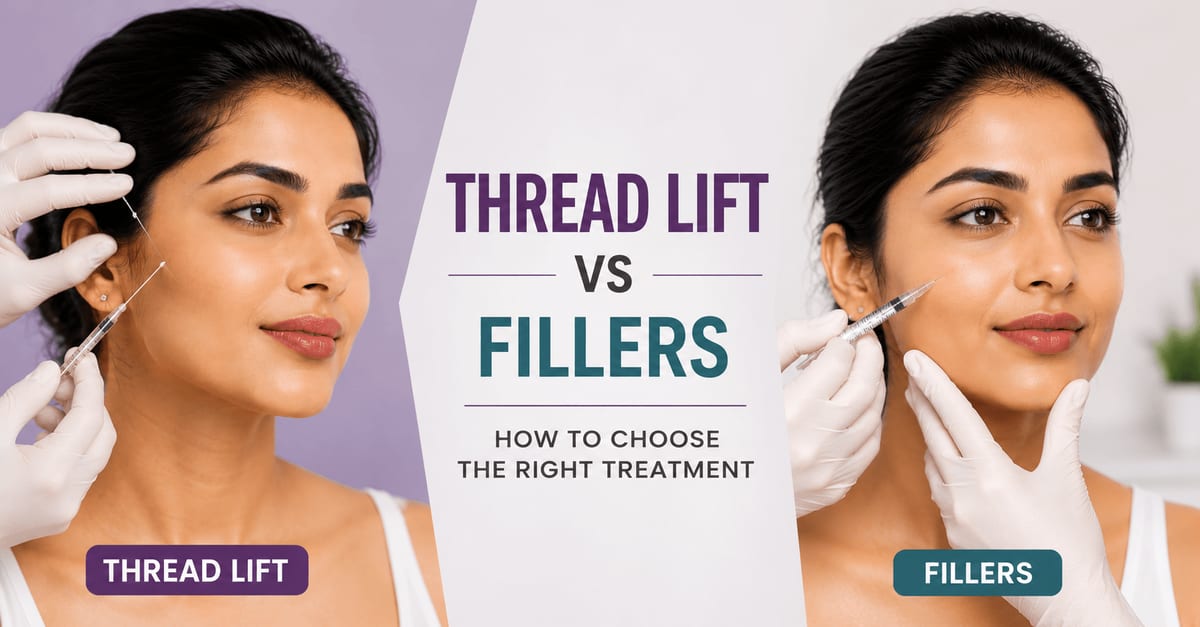
A thread lift primarily lifts.
Fillers primarily restore volume.
Choosing the wrong treatment can lead to disappointment, unnecessary expense, or an unnatural result.
At Derma Solutions in Marathahalli, Bengaluru, I see patients from Whitefield, Bellandur, Sarjapur Road, Electronic City, HSR Layout, Koramangala, and Indiranagar who often arrive after watching social media videos that make every procedure look suitable for everyone.
Real facial rejuvenation is more nuanced than that.
Before deciding between threads and fillers, we first need to understand what has actually changed in your face.
Why Does the Face Start Looking Tired?
Most people think ageing is only about wrinkles.
In reality, several changes happen together:
- Collagen gradually decreases.
- Skin becomes less firm.
- Fat pads shift downward.
- Cheeks lose support.
- The jawline becomes softer.
- Nasolabial folds become deeper.
- Under-eye hollowness increases.
These changes create a heavier, less defined appearance.
The important question is:
Is the problem primarily sagging, volume loss, or both?
That answer usually determines whether thread lift, fillers, or a combination treatment will give the best result.
What Is a Thread Lift?
A thread lift is a minimally invasive procedure that uses dissolvable medical threads placed beneath the skin to gently reposition and support sagging tissues.
Think of it as creating a subtle internal support structure.
The threads:
- Lift mild to moderate sagging
- Improve jawline definition
- Elevate the mid-face
- Stimulate collagen production over time
- Provide gradual skin tightening
The result is usually a more lifted and contoured appearance, not a dramatically fuller face.
Thread lifts are often chosen by patients who say:
“My face has dropped.”
Rather than:
“My face looks hollow.”
What Are Dermal Fillers?
Dermal fillers are injectable gels, most commonly made from hyaluronic acid, that restore lost volume and improve facial support.
Fillers can:
- Restore cheek volume
- Improve under-eye hollowness
- Soften smile lines
- Enhance the jawline
- Improve chin projection
- Rebalance facial proportions
The goal is usually structural support and volume restoration, not lifting loose skin.
Patients who benefit most often say:
“My face looks deflated.”
The Most Important Concept: Lift vs Volume
Thread Lift – Lift
Fillers – Volume
This is the simplest way to remember the difference.
Choose Thread Lift When
- Jawline has become soft
- Cheeks have descended slightly
- Mild jowls are present
- Neck skin feels loose
- You want a lifting effect
- You do not want added facial fullness
Choose Fillers When
- Cheeks look hollow
- Under-eyes appear sunken
- Smile lines are deeper
- Chin lacks projection
- Face appears deflated
- You want structural support
Many patients actually have both problems, which is why combination treatment is common.
Who Is a Better Candidate for Thread Lift?
In my experience, the best thread lift candidates are usually in their late 30s to 50s with mild to moderate skin laxity.
You may be a good candidate if:
- Your jawline has lost definition.
- Early jowls have appeared.
- Your cheeks have shifted downward.
- You still have reasonable skin elasticity.
- You want subtle lifting without surgery.
- You understand that results are natural, not dramatic.
A common misconception
Thread lifts are not a replacement for a surgical facelift.
They work best for early to moderate sagging, not severe skin laxity.
Who Is a Better Candidate for Fillers?
Fillers are often ideal for patients with volume loss rather than significant sagging.
You may be a good candidate if:
- Your cheeks look flatter than before.
- Under-eye hollowness makes you appear tired.
- Smile lines have become more noticeable.
- Your chin lacks projection.
- You have lost facial fullness after weight loss.
- You want immediate improvement with minimal downtime.
Fillers can also be used strategically to support facial structures, which may create a mild lifting effect even without threads.
Which Treatment Works Best for Specific Areas?
| Concern | Usually Better With |
|---|---|
| Early jowls | Thread Lift |
| Jawline definition | Threads or Fillers |
| Cheek hollowness | Fillers |
| Under-eye hollowness | Fillers |
| Mild mid-face sagging | Thread Lift |
| Deep smile lines | Fillers |
| Neck laxity | Thread Lift |
| Facial deflation after weight loss | Fillers |
This is why an in-person assessment is so important. Two patients may both say, “I want a sharper jawline,” yet one may need threads while the other needs filler support.
The Mistake I See Most Often
Many patients request a specific treatment before understanding the problem.
For example:
“I want threads because my friend got them.”
But after examination, the real issue may be volume loss.
Similarly:
“I want fillers because my cheeks look low.”
Yet the cheeks may have descended rather than deflated.
Choosing treatment based on social media instead of facial anatomy is one of the most common reasons patients feel disappointed.
My Approach at Derma Solutions
When someone asks me, “Thread lift or fillers?” I rarely answer immediately.
First, I assess:
- Skin elasticity
- Degree of sagging
- Volume loss
- Jawline structure
- Cheek support
- Facial symmetry
- Ageing pattern
- Previous treatments
- Long-term goals
Only then do we decide whether threads, fillers, or a combination approach will create the most natural result.
The best treatment is not the newest treatment.
It is the one that matches your face.
Can Thread Lift and Fillers Be Combined?
One of the biggest misconceptions is that you must choose either a thread lift or fillers.
In reality, many patients achieve the most natural results by combining both treatments.
Why?
Because facial ageing rarely happens due to a single factor.
As we age:
- Skin loses elasticity.
- Fat pads shrink and shift.
- Collagen production decreases.
- Facial support structures weaken.
- The jawline becomes less defined.
A thread lift can reposition mildly sagging tissues.
Dermal fillers can restore lost volume and improve facial contours.
Together, they often complement each other beautifully.
For example:
A patient with mild cheek sagging and hollow cheeks may benefit from:
- Thread lift to elevate the cheeks
- Fillers to restore cheek volume
- Botox (if indicated) to soften expression lines
- Skin boosters to improve hydration and skin quality
The goal is never to make the face look “done.”
It is to restore harmony.
Which Treatment Gives More Natural Results?
Patients often ask,
“Doctor, which one looks more natural?”
The answer depends less on the product and more on the treatment plan.
Natural-looking results come from:
- Proper patient selection
- Conservative treatment
- Correct facial assessment
- Understanding facial anatomy
- Respecting masculine and feminine facial proportions
When performed correctly:
A thread lift should not make your face appear overly tight.
Fillers should not make your face appear puffy.
Unfortunately, over-treatment is one of the biggest reasons cosmetic procedures look unnatural.
At Derma Solutions, my philosophy is simple:
Enhance, don’t exaggerate.
The best compliment after treatment should be:
“You look fresh.”
Not,
“What procedure did you have?”
Recovery Time: Thread Lift vs Fillers
Downtime is another important consideration.
After a Thread Lift
Most patients can return to routine activities within a few days.
You may experience:
- Mild swelling
- Tenderness
- Bruising
- Tightness while smiling or chewing
These effects generally improve over one to two weeks.
Your dermatologist may advise avoiding vigorous exercise, facial massages, and sleeping on your side for a short period.
After Dermal Fillers
Recovery is usually quicker.
Most patients experience only:
- Mild swelling
- Temporary redness
- Occasional bruising
Many patients return to work the same day or the following day.
Which Treatment Lasts Longer?
This is another frequently asked question.
There is no universal answer because longevity depends on:
- Type of product used
- Area treated
- Individual metabolism
- Lifestyle factors
- Skin quality
- Age
In general:
Thread Lift
Results often last around 12–18 months, although collagen stimulation may continue beyond this period.
Dermal Fillers
Depending on the product and treatment area, results commonly last 9–18 months.
Some areas naturally metabolise filler faster than others.
Maintenance treatments are usually recommended to preserve results.
Does Either Treatment Prevent Ageing?
Neither procedure stops the ageing process.
Ageing continues because of:
- Genetics
- Sun exposure
- Collagen loss
- Hormonal changes
- Lifestyle
- Gravity
- Environmental factors
However, these treatments may help patients maintain a fresher appearance as ageing progresses.
The best long-term strategy combines:
- Sunscreen
- Medical-grade skincare
- Healthy lifestyle habits
- Appropriate aesthetic treatments when needed
Thread Lift vs Fillers: Which Is Better for Different Concerns?
Sagging Jawline
A thread lift is often more suitable because it repositions tissues.
However, jawline fillers may also improve definition in selected patients.
Hollow Cheeks
Fillers generally provide better correction because they replace lost volume.
Nasolabial Folds
These folds often develop because of cheek descent and volume loss.
Some patients benefit from fillers.
Others require lifting of the mid-face.
Sometimes both treatments are appropriate.
Under-Eye Hollows
Dermal fillers are usually preferred.
Threads are generally not used for tear trough correction.
Mild Jowls
Thread lift may provide subtle lifting.
Patients with advanced skin laxity may require surgical consultation instead.
Facial Contouring
Fillers remain one of the most versatile options for enhancing:
- Chin projection
- Jawline
- Cheeks
- Temples
Common Mistakes Patients Make
Choosing a Procedure Instead of Solving the Problem
Many patients arrive saying,
“I want fillers.”
Or,
“I want threads.”
Instead, ask:
“What treatment is best for my concerns?”
A proper diagnosis always comes before choosing a procedure.
Expecting Surgical Results
Thread lifts provide subtle lifting.
They do not replace a facelift.
Patients expecting dramatic changes may feel disappointed.
Realistic expectations are essential.
Looking Only at Price
Choosing treatment solely because it is cheaper can lead to poor outcomes.
Experience, facial assessment, product quality, and technique all matter.
A well-planned treatment often delivers better value than repeated corrections.
Following Social Media Trends
Trends change rapidly.
Your face is unique.
What works for an influencer may not be appropriate for your facial anatomy.
What Happens During a Consultation at Derma Solutions?
Every consultation begins with listening.
I ask:
What concerns you most?
What changes have you noticed?
What result are you hoping to achieve?
I then assess:
- Skin elasticity
- Facial volume
- Sagging
- Bone structure
- Facial symmetry
- Skin quality
- Previous cosmetic procedures
- Medical history
Only after this assessment do we recommend treatment.
Some patients benefit from threads.
Others benefit from fillers.
Some require neither.
Our goal is to recommend only what genuinely improves your appearance.
My Advice Before Choosing Any Cosmetic Procedure
Don’t choose based on advertisements.
Don’t choose based on celebrity trends.
Don’t choose based on discounts.
Choose based on:
- Proper diagnosis
- Facial anatomy
- Long-term goals
- Safety
- Natural-looking outcomes
The most beautiful cosmetic treatment is the one that nobody notices.
Frequently Asked Questions
1. Which is better, thread lift or fillers?
Neither treatment is universally better.
Thread lifts primarily improve mild skin sagging, while fillers restore lost facial volume.
The best option depends on your facial anatomy and ageing pattern.
2. Can I get both thread lift and fillers together?
Yes.
Many patients achieve optimal results through combination treatment because ageing often involves both sagging and volume loss.
3. Is a thread lift painful?
The procedure is usually performed under local anaesthesia, making it well tolerated by most patients.
Some mild soreness may occur afterwards.
4. Are fillers painful?
Most fillers contain a local anaesthetic, and topical numbing cream is often applied before treatment.
Discomfort is usually minimal.
5. Which treatment has less downtime?
Dermal fillers generally involve less downtime than thread lifts.
Most patients resume normal activities within one day.
6. How long does a thread lift last?
Results commonly last around 12–18 months, depending on individual factors.
7. How long do fillers last?
Depending on the product and treatment area, fillers usually last between 9 and 18 months.
8. Can fillers make my face look puffy?
Only if excessive amounts are used or treatment is poorly planned.
Conservative filler placement produces natural-looking results.
9. Will a thread lift replace a facelift?
No.
Thread lifts are designed for mild to moderate skin laxity.
Patients with advanced sagging may require surgical options.
10. Which treatment is better for jawline definition?
It depends.
Some patients require threads.
Others require fillers.
Many benefit from combining both.
11. Which treatment is better for cheek enhancement?
Fillers are generally preferred when volume loss is the primary concern.
12. Are these treatments safe for Indian skin?
Yes.
Both thread lifts and hyaluronic acid fillers are suitable for Indian skin when performed by an experienced dermatologist using approved products.
13. Can these procedures be reversed?
Most hyaluronic acid fillers can be dissolved if necessary.
Thread lifts naturally dissolve over time.
14. At what age should I consider these treatments?
There is no ideal age.
Treatment depends on your skin condition, facial anatomy, and ageing pattern rather than your chronological age.
15. How do I know which treatment is right for me?
A comprehensive facial assessment by a qualified dermatologist is the most reliable way to determine the appropriate treatment plan.
Final Thoughts
Thread lifts and dermal fillers are often compared as competing treatments.
In reality, they solve different problems.
Thread lifts address skin laxity and tissue descent.
Dermal fillers restore volume and structural support.
For many patients, the best results come not from choosing one over the other, but from selecting the right treatment—or combination of treatments—based on a thorough facial assessment.
At Derma Solutions, my philosophy is never to recommend procedures simply because they are popular.
Instead, I focus on understanding why your face has changed and recommending treatments that enhance your natural features while preserving facial balance.
A successful cosmetic treatment should not make you look like someone else.
It should help you look like a healthier, more refreshed version of yourself.
References
- American Society for Dermatologic Surgery (ASDS) – https://www.asds.net/
- American Academy of Dermatology (AAD) – https://www.aad.org/
- NCBI Bookshelf – Dermal Fillers: https://www.ncbi.nlm.nih.gov/books/NBK470446/
- PubMed – Consensus Recommendations on Hyaluronic Acid Fillers: https://pubmed.ncbi.nlm.nih.gov/30353551/
- PubMed – Thread Lifting: Techniques and Outcomes: https://pubmed.ncbi.nlm.nih.gov/36257789/