
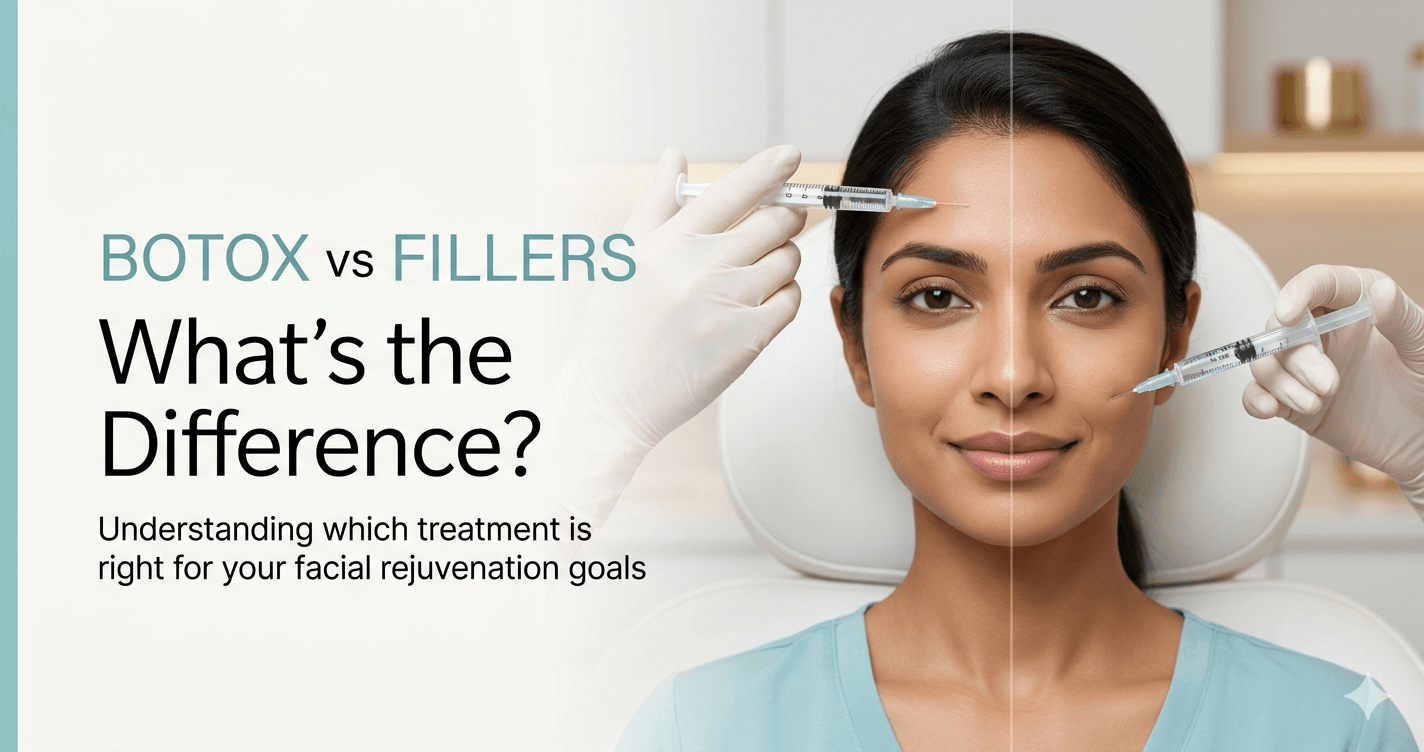
If you’ve been researching non-surgical anti-aging treatments, chances are you’ve come across two names repeatedly: Botox and dermal fillers.
Many people assume they’re interchangeable, but they actually address different concerns and work in completely different ways.
As a dermatologist, one of the most common questions I hear from patients is:
The answer depends on why your face is changing, not simply your age.
At Derma Solutions, Bengaluru, our approach is to understand facial anatomy, aging patterns, and individual goals before recommending any injectable treatment. The best results come from preserving natural expressions while subtly restoring harmony and balance.
This guide explains the differences between Botox and dermal fillers, who can benefit from each, and how to choose the right treatment for your needs.
Facial aging is a gradual process involving much more than wrinkles.
Over time, the skin undergoes structural changes that affect its appearance and elasticity.
Some of the most important age-related changes include:
These changes lead to two broad categories of concerns:
Dynamic wrinkles develop because facial muscles repeatedly contract whenever we smile, frown, laugh, or raise our eyebrows.
Initially, these lines appear only during expression.
As years pass, they may become visible even when the face is at rest.
Examples include:
These wrinkles are primarily caused by muscle activity.
Aging also causes gradual loss of collagen, fat, and facial support.
This may result in:
These concerns are related to volume depletion rather than muscle movement.
Because these problems have different causes, they require different treatments.
Botox is the brand name most people use for botulinum toxin injections used in aesthetic medicine.
It works by temporarily relaxing selected facial muscles responsible for repetitive expressions.
By reducing excessive muscle activity, Botox softens expression lines and helps prevent them from becoming deeper over time.
Contrary to popular belief, Botox does not fill wrinkles or add facial volume.
Instead, it reduces the force that creates certain wrinkles in the first place.
When performed conservatively by an experienced dermatologist, the goal is not to eliminate expression but to soften unwanted lines while maintaining natural facial movement.
Every facial movement begins with nerve signals that instruct muscles to contract.
Botox temporarily blocks these signals in carefully selected muscles.
As those muscles relax:
The surrounding muscles continue functioning normally, allowing patients to retain a refreshed and natural appearance.
Results typically begin appearing within several days and continue improving over the next one to two weeks.
Botox is commonly used for:
Horizontal lines caused by repeatedly raising the eyebrows often respond well to Botox.
Vertical lines between the eyebrows, sometimes called “11 lines,” can soften significantly after treatment.
Fine wrinkles at the outer corners of the eyes caused by smiling and squinting are among the most frequently treated areas.
Small wrinkles appearing on the sides of the nose during facial expressions may improve with carefully placed injections.
Botox can help smooth an overly active chin muscle that creates an orange-peel appearance.
Selected patients may benefit from treatment targeting prominent vertical neck bands.
In addition to cosmetic uses, botulinum toxin is also used medically for conditions such as excessive sweating, chronic migraine, muscle spasms, and teeth grinding in appropriate cases.
Patients often choose Botox because it offers:
For younger patients, Botox may also play a preventive role by reducing repetitive muscle activity before deep static wrinkles develop.
Results vary between individuals but generally last three to six months.
Several factors influence longevity:
Maintenance sessions are often recommended to preserve results.
Importantly, Botox does not permanently weaken muscles or accelerate aging when used appropriately.
Dermal fillers are injectable gels designed to restore facial volume, enhance contours, and improve structural support.
Unlike Botox, fillers do not affect muscle movement.
Instead, they physically replenish areas where natural volume has diminished.
Many commonly used fillers contain hyaluronic acid, a substance naturally present in human skin that attracts and retains water, contributing to hydration and fullness.
When strategically placed, fillers can restore youthful proportions while maintaining facial harmony.
Aging often causes soft tissue volume loss beneath the skin.
Dermal fillers replace some of this lost support, helping lift and contour targeted areas.
Depending on the treatment plan, fillers may:
The objective is refinement rather than dramatic alteration.
Well-executed filler treatments should leave people saying you look refreshed—not that you’ve “had work done.”
Dermal fillers may be used in carefully selected patients for:
Restoring cheek volume can improve mid-face support and create a more youthful appearance.
Fillers can enhance shape, definition, hydration, and balance while maintaining natural proportions.
Improving chin projection may enhance facial profile and jawline harmony.
Strategic contouring can create better definition and improve lower-face balance.
Selected patients with tear trough concerns may benefit from carefully placed filler treatment.
Volume restoration around the cheeks often indirectly softens smile lines extending from the nose to the mouth.
Support around the lower face can reduce the appearance of lines extending downward from the corners of the mouth.
Dermal fillers offer several advantages:
Unlike Botox, fillers directly address structural volume loss, making them particularly valuable for age-related facial hollowing.
| Feature | Botox | Dermal Fillers |
|---|---|---|
| Primary action | Relaxes muscles | Restores volume |
| Best for | Dynamic wrinkles | Volume loss and contouring |
| Typical onset | 3–14 days | Immediate |
| Duration | 3–6 months | 6–24 months depending on product |
| Prevents wrinkle formation | Yes | Limited |
| Adds facial volume | No | Yes |
| Facial contouring | Minimal | Excellent |
| Lip enhancement | No | Yes |
| Cheek restoration | No | Yes |
If your primary concern is wrinkles that appear when you smile, frown, or raise your eyebrows, Botox may be the more suitable option.
If your concern is hollow cheeks, thinning lips, facial imbalance, or age-related volume loss, dermal fillers may provide greater benefit.
However, facial aging rarely involves only one process.
Many patients exhibit both muscle-related wrinkles and structural volume changes, making a personalized treatment plan more effective than relying on a single procedure.
Absolutely.
In fact, one of the biggest misconceptions in aesthetic medicine is that patients must choose either Botox or fillers. In reality, these treatments are often complementary rather than competitive.
Botox addresses dynamic wrinkles caused by muscle movement, while dermal fillers address volume loss, contour deficiencies, and structural aging.
When used together in appropriate candidates, they can create balanced and natural-looking facial rejuvenation.
For example:
This combination approach is sometimes referred to as a non-surgical or “liquid facelift.”
The objective is never to make someone look like a different person.
Instead, the goal is to help patients look refreshed, well-rested, and naturally youthful while preserving facial identity.
One of the most common fears patients express is:
“I don’t want to look fake.”
This concern is understandable, especially when social media often highlights exaggerated cosmetic results.
The truth is that unnatural outcomes are usually the result of poor treatment planning, excessive product use, or inappropriate injection techniques—not Botox or fillers themselves.
A skilled dermatologist focuses on:
Modern aesthetic medicine emphasizes subtle enhancement rather than dramatic transformation.
Friends and family should notice that you look fresher—not necessarily that you’ve undergone treatment.
Botox may be suitable for adults who wish to reduce expression-related wrinkles or proactively slow wrinkle formation.
Patients commonly seek Botox for:
Ideal candidates should have realistic expectations and understand that results are temporary and require maintenance.
Dermal fillers may benefit patients experiencing:
Not every patient needs filler.
The decision should always follow a detailed facial assessment rather than trends or social media influence.
Although Botox and dermal fillers are minimally invasive procedures, they remain medical treatments and should never be viewed as routine beauty services.
Before recommending injectable treatments, an experienced dermatologist evaluates:
Patients should always disclose their complete medical history to ensure treatment safety.
Most Botox and filler appointments are relatively quick and can often be completed within 15 to 45 minutes, depending on the areas treated.
The process generally includes:
Many patients resume routine daily activities shortly afterward, although individualized aftercare recommendations should always be followed.
Recovery is usually straightforward.
Patients may experience temporary:
These effects often resolve within a few days.
General aftercare recommendations may include:
Because every patient is different, aftercare instructions should always be personalized.
Most patients experience results lasting approximately 3 to 6 months.
Repeated maintenance sessions can help preserve wrinkle reduction over time.
Longevity varies depending on:
Many hyaluronic acid fillers provide improvement lasting 6 to 24 months, although this varies significantly between individuals.
False.
Botox relaxes muscles, while fillers restore volume.
False.
When administered appropriately, Botox softens wrinkles while allowing natural expression.
False.
Properly performed lip enhancement focuses on balance and proportion rather than excessive volume.
False.
Some younger adults choose Botox preventively or seek fillers for facial balancing rather than age-related changes.
False.
Both Botox and most hyaluronic acid fillers provide temporary improvements and may require maintenance.
False.
Conservative treatment often produces the most elegant and natural-looking outcomes.
Your results depend not only on the product but also on the expertise of the person performing the injections.
Facial anatomy is complex, involving muscles, nerves, blood vessels, fat compartments, and bone structure.
Safe and effective treatment requires:
Choosing treatment based solely on price or promotional offers may increase the risk of unsatisfactory outcomes.
Neither is universally better. Botox is ideal for muscle-related wrinkles, while fillers restore lost volume and improve facial contours. The best choice depends on your specific concerns.
There is no ideal age. Some patients begin in their late 20s or 30s for preventive wrinkle management, while others seek treatment later when expression lines become more noticeable.
Botox is generally not the primary treatment for volume-related smile lines. Dermal fillers or combination approaches may be more appropriate after assessment.
Yes. When carefully planned and conservatively administered, fillers can enhance facial harmony while maintaining a natural appearance.
Most patients describe Botox injections as causing only mild, brief discomfort. Fine needles and careful technique help minimize pain.
Botox typically begins working within a few days and reaches full effect in about one to two weeks. Dermal fillers generally provide immediate volume enhancement, although minor swelling may temporarily affect appearance.
In many appropriate cases, yes. Combining treatments can provide comprehensive facial rejuvenation and reduce the need for multiple visits.
The goal of expert aesthetic medicine is subtle enhancement. Most patients simply appear fresher or more rested rather than obviously treated.
No. Both treatments gradually wear off over time and may require maintenance sessions if patients wish to preserve their results.
The best approach is an individualized consultation with a qualified dermatologist who can evaluate your facial anatomy, skin quality, aging pattern, and aesthetic goals before recommending a personalized plan.
Botox and dermal fillers are among the most popular non-surgical aesthetic treatments worldwide, but they are designed to solve different problems.
If expression-related wrinkles are your primary concern, Botox may provide the most benefit.
If facial volume loss, contour deficiencies, or structural aging are your main concerns, dermal fillers may be more appropriate.
For many patients, the optimal solution is a customized combination of both treatments.
At Derma Solutions, Bengaluru, every face is assessed individually. Rather than following trends or standardized protocols, treatment recommendations are tailored to each patient’s anatomy, concerns, and long-term goals.
The aim is not to change your face—it is to help you look like the best version of yourself while preserving natural beauty and facial harmony.

Written by: Dr. Sandeep Mahapatra
Senior Dermatologist, Hair Transplant Surgeon & Founder – Derma Solutions Skin & Hair Clinic, Bangalore
Dr. Sandeep Mahapatra is a senior dermatologist and hair transplant surgeon in Bangalore with extensive experience in dermatology, aesthetic treatments and hair restoration. As the founder of Derma Solutions Skin and Hair Clinic – Marathahalli, Bangalore , With extensive experience in aesthetic dermatology, he has performed 50,000+ laser hair removal treatments, 40,000+ chemical peels, 4,000+ Botox procedures, 2,000+ dermal filler treatments, and 3,000+ vitiligo treatments, helping patients achieve safe, natural-looking, and evidence-based skin and facial rejuvenation results.
Medically reviewed by: Dr. Sandeep Mahapatra
Senior Dermatologist & Hair Transplant Surgeon
Date Reviewed: 2026-06-17
This article has been medically reviewed by Dr. Sandeep Mahapatra to ensure Blog Author & Medical Reviewer