Table of Contents
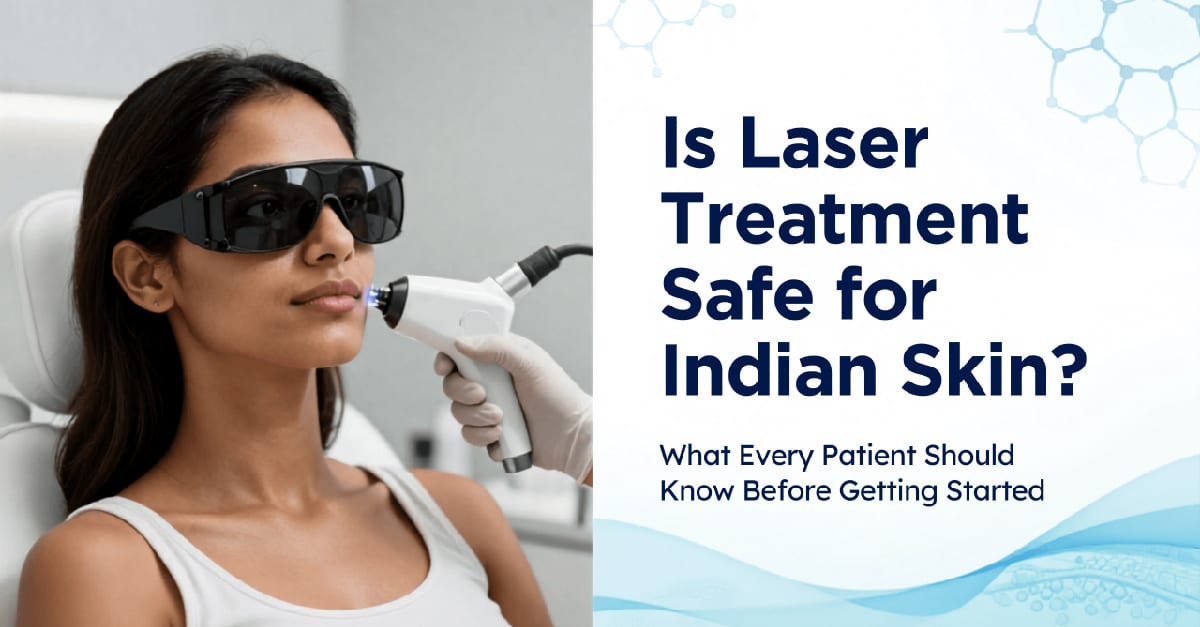
If you have ever searched for laser hair reduction, acne scar treatment, pigmentation removal, skin resurfacing, or facial rejuvenation, you have probably come across conflicting advice.
Some people say laser treatments are completely safe. Others warn that they can burn Indian skin, leave permanent dark marks, or only work well for fair complexions.
As a dermatologist, I understand why these concerns exist.
Indian skin behaves differently from lighter skin types because it contains more melanin, the pigment responsible for skin colour. This characteristic requires careful planning and individualized treatment. However, it does not mean that laser procedures are inherently unsafe.
In fact, modern laser technology has made it possible to safely and effectively treat a wide variety of skin concerns in patients with Indian skin—provided the treatment is performed by an experienced dermatologist using the appropriate device, customized settings, and proper aftercare.
Unfortunately, many complications occur not because lasers are dangerous but because treatments are performed without adequate assessment, with outdated equipment, or by operators who lack sufficient medical training.
The purpose of this guide is to help you understand how laser treatments work, why Indian skin deserves a specialized approach, and how to make informed decisions before undergoing any procedure.
Why So Many Indians Are Worried About Laser Treatments
Every week, patients visit dermatology clinics with questions like:
- “Will laser treatment make my skin darker?”
- “Can laser burn brown skin?”
- “Is laser only meant for fair-skinned people?”
- “My friend developed pigmentation after laser. Will that happen to me?”
- “Is laser hair reduction safe for Indian skin?”
These concerns are understandable because stories of poor outcomes often spread faster than stories of successful treatment.
However, many of these experiences share a common theme: the issue was not the concept of laser therapy itself but inappropriate patient selection, incorrect treatment settings, inadequate aftercare, or treatment performed by individuals without sufficient dermatological expertise.
Laser technology has evolved tremendously over the past decade. When used correctly, it has become one of the most effective tools available for treating unwanted hair, acne scars, pigmentation disorders, vascular lesions, and signs of ageing in patients with melanin-rich skin.
Understanding Indian Skin and Why It Requires Special Care
Indian skin typically falls within Fitzpatrick Skin Types III, IV, and V, although individual variation exists.
Compared with lighter skin tones, Indian skin contains a greater concentration of melanin within the epidermis. Melanin naturally protects against ultraviolet radiation and contributes to our diverse complexions, but it also absorbs laser energy.
This characteristic makes laser treatment more technically demanding.
When a laser emits energy into the skin, it targets specific structures known as chromophores. In procedures such as laser hair reduction, melanin inside the hair follicle is intentionally targeted. However, epidermal melanin can also absorb some of that energy.
If excessive energy is delivered too quickly or inappropriate wavelengths are used, the surrounding skin may become irritated, increasing the risk of temporary pigmentation changes.
For this reason, Indian skin requires thoughtful customization rather than aggressive treatment.
An experienced dermatologist carefully balances safety and effectiveness by selecting suitable wavelengths, pulse durations, cooling systems, and energy settings based on each patient’s skin type and clinical concern.
The Truth About Laser Safety for Brown and Melanin-Rich Skin
One of the biggest misconceptions is that laser treatments are unsafe for darker complexions.
This is simply not true.
Modern dermatology routinely uses lasers in patients with Indian skin for concerns including:
- Unwanted facial and body hair
- Acne scars
- Pigmentation disorders
- Sun damage
- Fine wrinkles
- Skin rejuvenation
- Enlarged pores
- Surgical scars
- Certain benign vascular lesions
The key lies in selecting the appropriate technology and tailoring treatment to the individual.
Safe laser practice begins long before the procedure itself. It starts with an in-depth consultation that includes assessment of medical history, medications, previous procedures, sun exposure, skin sensitivity, active infections, and expectations.
Only after understanding these factors should treatment parameters be determined.
Common Myths About Laser Treatment—Debunked
Myth 1: Laser Treatments Always Burn Indian Skin
Modern medical lasers are designed with sophisticated cooling mechanisms and adjustable parameters.
Burns are uncommon when procedures are performed correctly by trained professionals using appropriate technology.
Complications are more likely when treatments are rushed, settings are overly aggressive, or unsuitable devices are used.
Myth 2: Laser Permanently Darkens the Skin
Many patients worry about becoming darker after laser therapy.
In reality, permanent darkening is uncommon.
Some individuals may temporarily develop post-inflammatory hyperpigmentation, especially if the skin becomes irritated or aftercare instructions are ignored. Fortunately, this pigmentation usually improves with time and appropriate management.
Preventive strategies—including conservative settings, sun protection, and individualized protocols—substantially reduce this risk.
Myth 3: Lasers Only Work for Fair-Skinned People
Advances in laser technology have significantly expanded treatment options for patients with darker complexions.
Devices and protocols can now be adapted to safely treat melanin-rich skin while minimizing unwanted side effects.
Success depends on choosing the correct technology rather than attempting to use the same settings for every patient.
Different Laser Treatments and Their Uses
Many people assume there is only one type of laser, but dermatology uses different technologies for different concerns.
Laser Hair Reduction
Laser hair reduction targets pigment within actively growing hair follicles to reduce future hair growth over multiple sessions.
Treatment is commonly used for the face, underarms, legs, arms, chest, back, and bikini area. Results are gradual, and maintenance sessions may be required depending on hormonal factors and individual biology.
Acne Scar Treatment
Acne scars require a completely different approach.
Fractional lasers create controlled microscopic zones of skin remodeling that stimulate collagen production and improve texture over time.
Improvement occurs gradually across several months as the skin heals and new collagen forms.
Pigmentation Treatment
Certain pigmentary conditions may respond well to carefully selected laser procedures.
However, not every patch of pigmentation should be treated with a laser. Some conditions require topical medications, chemical peels, sun protection, or combination therapy instead.
Proper diagnosis is therefore essential before proceeding.
Skin Rejuvenation and Resurfacing
Laser resurfacing can improve fine lines, uneven texture, enlarged pores, and photoaging by encouraging collagen remodeling.
Treatment intensity varies from mild procedures with minimal downtime to deeper resurfacing that requires longer recovery.
The ideal approach depends on age, skin type, lifestyle, and treatment goals.
Why Choosing the Right Laser Matters More Than Choosing the Cheapest Package
Patients often compare clinics based on price alone.
However, laser treatment is not a commodity where every machine produces identical results.
Different devices operate at different wavelengths and interact with skin in different ways. Some offer superior safety profiles for darker skin tones, while others require greater caution.
Equally important is the expertise of the person operating the equipment.
An experienced dermatologist understands skin biology, wound healing, pigment behavior, laser physics, and complication management. This knowledge guides individualized treatment decisions that cannot be replaced by promotional offers or heavily discounted packages.
When evaluating laser treatment, patients should prioritize safety, appropriate technology, medical supervision, and transparent counselling over cost alone.
Preparing for Your First Laser Session
Proper preparation improves both safety and outcomes.
Patients may be advised to:
- Avoid excessive sun exposure before treatment.
- Use sunscreen consistently.
- Inform the dermatologist about medications.
- Report previous skin reactions or procedures.
- Avoid waxing or plucking before laser hair reduction.
- Postpone treatment if active infections are present.
- Follow individualized skincare instructions.
Every procedure should begin with consultation—not immediate treatment.
Aftercare: What You Do After Treatment Matters
Recovery continues long after you leave the clinic.
General aftercare recommendations often include:
- Protecting skin from sunlight
- Applying prescribed moisturizers
- Avoiding harsh exfoliants
- Avoiding unnecessary friction
- Following medication instructions
- Keeping treated skin clean
- Avoiding picking or scratching healing areas
Patients should never self-medicate or apply home remedies unless advised.
Good aftercare often contributes significantly to successful outcomes.
Who Should Avoid or Postpone Laser Procedures?
Laser treatments may need postponement in situations such as:
- Active skin infections
- Severe sunburn
- Certain photosensitive conditions
- Uncontrolled medical illnesses
- Open wounds
- Some inflammatory skin diseases
- Recent tanning
- Certain medications affecting healing
Pregnancy considerations vary depending on the procedure and should be discussed individually with the treating dermatologist.
Setting Realistic Expectations
Laser procedures rarely produce dramatic transformation after one session.
Improvement usually occurs gradually as the skin heals and remodels.
For many treatments:
- Initial healing occurs over days to weeks.
- Visible improvement develops over several weeks.
- Collagen remodeling may continue for months.
- Multiple sessions may be recommended.
- Maintenance treatments may be appropriate for some conditions.
Patience and consistency often produce the best long-term outcomes.
Red Flags When Choosing a Laser Clinic
Patients should exercise caution if a clinic:
- Guarantees unrealistic results.
- Promises permanent cures in one sitting.
- Starts treatment without consultation.
- Uses identical settings for every patient.
- Focuses only on discounts rather than diagnosis.
- Cannot clearly explain risks and benefits.
- Delegates complex treatments without medical supervision.
A reputable dermatologist emphasizes informed consent and individualized planning.
Frequently Asked Questions (FAQs)
1. Is laser treatment safe for Indian skin?
Yes. Modern laser treatments are generally safe for Indian skin when performed by a qualified dermatologist using appropriate technology and customized treatment settings.
2. Can laser treatment permanently darken my skin?
Permanent darkening is uncommon. Some patients may experience temporary post-inflammatory hyperpigmentation, but proper technique and aftercare significantly reduce this risk.
3. Which laser is best for Indian skin?
The answer depends on your skin concern. Different lasers are used for hair reduction, acne scars, pigmentation, resurfacing, and rejuvenation. Your dermatologist will recommend the most suitable option after evaluation.
4. Is Fractional CO₂ laser safe for darker skin tones?
Fractional CO₂ laser can be used safely in appropriately selected Indian patients when treatment settings are carefully customized and performed by experienced professionals.
5. How many sessions will I need?
The number varies depending on the condition being treated, severity, skin response, and treatment goals. Many procedures require multiple sessions for optimal improvement.
6. Does laser hair reduction remove hair permanently?
Laser hair reduction significantly reduces hair growth but is generally considered long-term hair reduction rather than guaranteed permanent removal. Maintenance sessions may be needed.
7. Can laser help acne scars?
Yes. Fractional laser treatments are widely used to improve acne scars by stimulating collagen remodeling and skin regeneration.
8. Should I avoid sun exposure after laser treatment?
Yes. Sun protection is one of the most important aspects of aftercare and helps minimize pigmentation changes while supporting healing.
9. Are laser treatments painful?
Most patients describe the sensation as mild discomfort rather than severe pain. Cooling technologies and individualized protocols improve comfort during treatment.
10. How do I know if I am a suitable candidate?
A consultation with a qualified dermatologist is the best way to determine whether laser treatment is appropriate for your skin type, medical history, and specific concern.
Final Thoughts
Laser treatments have transformed modern dermatology and aesthetic medicine, offering effective solutions for hair reduction, acne scars, pigmentation, and skin rejuvenation.
For Indian skin, the question should not be “Are lasers safe?”
Instead, ask:
“Is this the right laser, for my skin type, being performed by the right dermatologist with the right treatment plan?”
When science, technology, and clinical expertise come together, laser procedures can deliver predictable, natural-looking improvements while maintaining the health and integrity of melanin-rich skin.
Always prioritize diagnosis over discounts and expertise over marketing claims.
Your skin deserves individualized care.
References
- American Academy of Dermatology Association. Laser Hair Removal: What to Know Before You Get It.
https://www.aad.org/public/cosmetic/hair-removal/laser-hair-removal-faqs - American Academy of Dermatology Association. Skin of Color Resource Center.
https://www.aad.org/public/everyday-care/skin-care-secrets/skin-of-color - DermNet NZ. Lasers in Dermatology.
https://dermnetnz.org/topics/lasers-in-dermatology - Nestor MS, et al. Laser Treatment in Patients with Fitzpatrick Skin Types IV–VI: Practical Considerations and Safety. Journal of Clinical and Aesthetic Dermatology.
https://www.ncbi.nlm.nih.gov/pmc/articles/PMC4830266/ - American Society for Dermatologic Surgery (ASDS). Laser and Light Treatments Overview.
https://www.asds.net/skin-experts/skin-treatments/laser-and-light-treatments