Table of Contents
Introduction: “Doctor, These Yellow Patches Around My Eyes Won’t Go Away.”
Many patients come to my clinic with the same concern.
They point towards the inner corners of their eyelids and ask,
“Doctor, are these cholesterol deposits?”
Others say,
“I’ve tried creams for months, but nothing has changed.”
Some are worried they may be cancer.
Others simply feel embarrassed because the patches have become more noticeable over time.
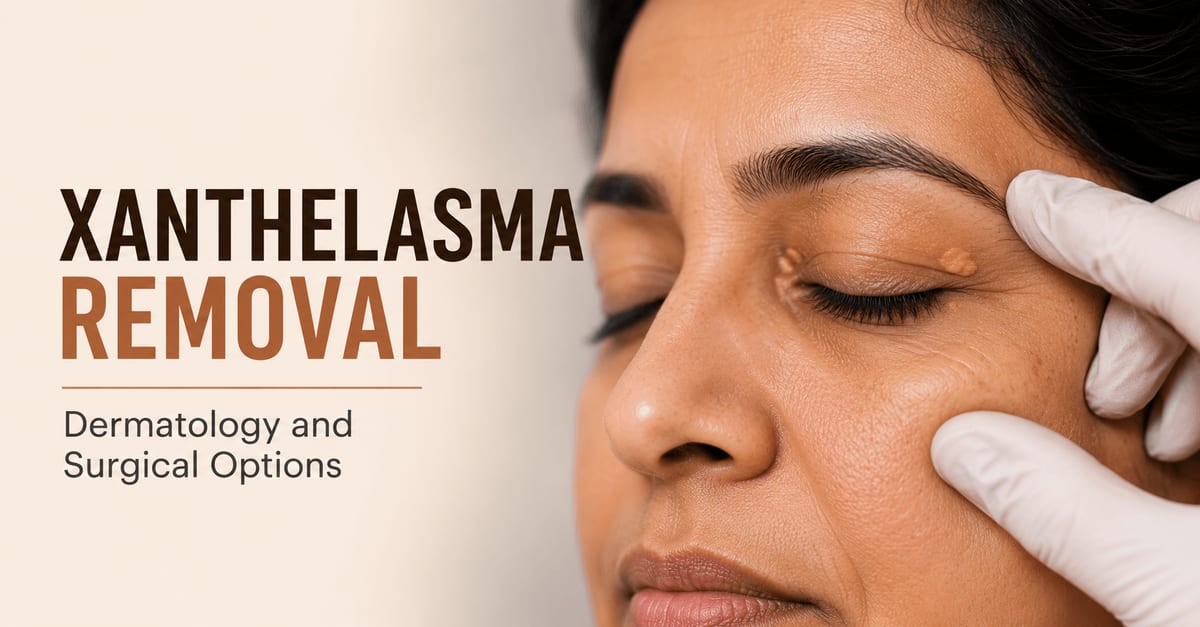
These soft, yellowish plaques around the eyelids are commonly called xanthelasma.
Although they are usually harmless, they often become a cosmetic concern because they appear on one of the most visible parts of the face.
At Derma Solutions in Marathahalli, Bengaluru, I frequently meet patients from Whitefield, Bellandur, Sarjapur Road, HSR Layout, Electronic City, Brookefield, and surrounding areas who want to understand whether xanthelasma can be removed permanently and whether it is linked to high cholesterol.
The good news is that several effective treatment options are available.
However, choosing the right treatment depends on the size, depth, location, and cause of the lesion.
In this guide, I’ll explain everything you should know before considering xanthelasma removal.
What Is Xanthelasma?
Xanthelasma is a benign (non-cancerous) deposit of cholesterol-rich material that forms just beneath the skin.
It most commonly appears as:
- Soft yellow plaques
- Slightly raised patches
- Flat or mildly elevated lesions
- Smooth surface
- Usually painless
These deposits most often develop on:
- Upper eyelids
- Lower eyelids
- Inner corners of the eyes (near the nose)
They can affect one eye or both eyes.
Sometimes they remain very small.
In other patients, they slowly enlarge over several years.
Is Xanthelasma Dangerous?
This is usually the first question patients ask.
The answer is reassuring.
Xanthelasma itself is not dangerous.
It is:
- Not cancer
- Not an infection
- Not contagious
- Usually painless
However, it can sometimes be a sign of an underlying lipid (cholesterol) disorder.
Approximately half of patients with xanthelasma may have abnormal cholesterol or triglyceride levels.
Others may have completely normal blood reports.
That is why proper medical evaluation is important.
Why Does Xanthelasma Develop?
The exact cause is not always straightforward.
Xanthelasma develops when cholesterol-containing cells accumulate within the skin around the eyelids.
Several factors may increase the risk.
High Cholesterol
Elevated LDL (“bad cholesterol”) is one of the best-known associations.
However, not everyone with xanthelasma has high cholesterol.
High Triglycerides
Raised triglycerides may also contribute.
Diabetes
Poorly controlled diabetes can increase the likelihood of lipid abnormalities.
Obesity
Higher body fat levels may increase the risk of abnormal cholesterol metabolism.
Family History
Some individuals inherit conditions that affect cholesterol metabolism.
Age
Xanthelasma becomes more common during middle age.
However, younger adults can also develop it.
Smoking
Smoking contributes to cardiovascular disease and may indirectly influence lipid metabolism.
Can You Have Xanthelasma Even If Your Cholesterol Is Normal?
Yes.
This surprises many patients.
Some individuals with completely normal lipid profiles still develop xanthelasma.
Researchers believe genetics, local skin factors, and individual cholesterol metabolism may also play a role.
Therefore, normal cholesterol does not completely rule out xanthelasma.
Similarly, not everyone with high cholesterol develops these deposits.
Who Is More Likely to Develop Xanthelasma?
Although anyone can develop xanthelasma, it is more frequently seen in people who have:
- High cholesterol
- Diabetes
- Obesity
- Family history of lipid disorders
- Metabolic syndrome
- Increasing age
Women appear to be affected slightly more often than men.
However, both genders can develop the condition.
What Does Xanthelasma Look Like?
Patients often mistake it for:
- Milia
- Skin tags
- Warts
- Eyelid cysts
- Fat deposits
Typical features include:
- Yellow colour
- Soft texture
- Flat or slightly raised appearance
- Located close to the inner eyelid
- Slow growth
- Usually painless
If a lesion looks unusual, grows rapidly, ulcerates, or bleeds, further evaluation is essential to exclude other conditions.
How Is Xanthelasma Diagnosed?
Diagnosis is usually clinical.
During consultation, I evaluate:
- Appearance
- Colour
- Size
- Location
- Number of lesions
- Duration
- Family history
- Medical history
Depending on your health profile, additional investigations may include:
- Lipid profile
- Blood sugar testing
- Liver function tests
- Thyroid evaluation (when clinically indicated)
The purpose is not only to treat the visible lesion but also to identify any underlying health concerns.
Can Creams Remove Xanthelasma?
This is one of the most common questions I receive.
Unfortunately, there is currently no scientifically proven cream that reliably removes established xanthelasma.
Many over-the-counter products promise dramatic results.
Most lack good clinical evidence.
Some may even irritate the delicate eyelid skin.
If a yellow plaque has formed beneath the skin, topical creams are unlikely to remove it completely.
Patients should be cautious about internet products claiming to “dissolve cholesterol deposits naturally.”
Can Diet Alone Make Xanthelasma Disappear?
A healthy diet is always beneficial.
Reducing saturated fats, increasing fibre intake, exercising regularly, and managing cholesterol help improve overall cardiovascular health.
However, once xanthelasma plaques have formed, dietary changes alone usually do not remove existing lesions.
Lifestyle modification remains important because it may reduce future cardiovascular risk and help manage cholesterol levels.
Should Everyone With Xanthelasma Get Their Cholesterol Checked?
In most adults, yes.
A lipid profile is often recommended because xanthelasma may sometimes be associated with abnormal cholesterol levels.
Even if cholesterol is normal, the evaluation provides useful information about your overall health.
Think of xanthelasma as an opportunity to assess cardiovascular risk rather than simply a cosmetic concern.
When Should Xanthelasma Be Removed?
Not every patient requires treatment.
Removal is usually considered when:
- The lesion is cosmetically bothersome.
- It continues to enlarge.
- It affects confidence.
- It interferes with makeup application.
- It creates eyelid asymmetry.
- The patient prefers definitive treatment.
The decision should always be individualised after proper examination.
Non-Surgical Treatment Options
Several minimally invasive treatments may be suitable depending on the depth and size of the lesion.
These include:
- Laser treatment
- Radiofrequency removal
- Chemical cauterisation (selected cases)
Each has specific advantages and limitations.
No single treatment is ideal for every patient.
The choice depends on careful clinical assessment.
Why Choosing the Right Treatment Matters
The eyelid is one of the thinnest and most delicate areas of the body.
Treatment requires precision.
Removing too little tissue increases the chance of recurrence.
Removing too much tissue may increase the risk of scarring or eyelid contour changes.
This is why xanthelasma treatment should ideally be performed by an experienced dermatologist or cosmetic surgeon familiar with eyelid anatomy.
My Approach at Derma Solutions
Every patient receives an individualised assessment.
During consultation, I evaluate:
- Size of the lesion
- Number of plaques
- Depth
- Skin quality
- Eyelid anatomy
- Medical history
- Lipid profile (when indicated)
- Previous treatments
Some patients are suitable for laser treatment.
Others achieve better outcomes with surgical excision or radiofrequency removal.
The goal is not simply removing the visible plaque.
It is achieving the best cosmetic result while minimising recurrence and preserving the natural appearance of the eyelid.
What Are the Treatment Options for Xanthelasma?
One of the biggest misconceptions about xanthelasma is that there is a single “best” treatment.
In reality, the ideal treatment depends on several factors, including:
- Size of the lesion
- Number of plaques
- Depth of cholesterol deposits
- Skin type
- Eyelid anatomy
- Previous treatments
- Patient expectations
At Derma Solutions, every treatment plan is personalised after carefully evaluating these factors.
Surgical Excision
Surgical removal remains one of the most reliable options, particularly for:
- Large xanthelasma plaques
- Deep cholesterol deposits
- Thick lesions
- Recurrent xanthelasma
During the procedure, the lesion is carefully excised while preserving as much healthy eyelid skin as possible.
The incision is planned along natural eyelid creases whenever feasible to minimise visible scarring.
Advantages
- Complete removal in many cases
- Suitable for larger lesions
- Tissue can be sent for laboratory examination if necessary
- Immediate removal
Considerations
Although surgery offers excellent results, every surgical procedure carries potential risks such as scarring, pigmentation changes, or recurrence. Proper patient selection and surgical technique are essential.
Laser Xanthelasma Removal
Laser treatment has become increasingly popular for carefully selected patients.
Different laser technologies may be used depending on the lesion and dermatologist’s preference.
Laser treatment works by precisely vaporising or ablating the abnormal tissue while minimising injury to surrounding skin.
Benefits
- Minimally invasive
- Precise treatment
- Minimal bleeding
- Suitable for small to medium plaques
- Short recovery time
Laser treatment is not necessarily superior for every patient.
Deep or extensive lesions may still require surgical removal.
Radiofrequency (RF) Removal
Radiofrequency surgery uses controlled high-frequency energy to remove abnormal tissue.
Many dermatologists favour RF because it provides excellent precision around delicate eyelid skin.
Potential advantages include:
- Controlled tissue removal
- Good cosmetic outcomes
- Minimal bleeding
- Relatively quick healing
Again, the success depends more on patient selection and operator experience than on the device itself.
Chemical Cauterisation
In carefully selected superficial lesions, chemical agents such as trichloroacetic acid (TCA) may be used.
This treatment causes controlled destruction of the affected tissue.
However, chemical cautery is generally reserved for selected patients because:
- Multiple sessions may be required.
- Precise application is essential.
- The delicate eyelid area increases the risk of pigmentary changes if not performed carefully.
It should only be performed by experienced professionals.
Which Treatment Is Best?
Patients often ask,
“Doctor, which option gives permanent results?”
There is no universal answer.
The most appropriate treatment depends on:
- Lesion size
- Lesion depth
- Skin quality
- Previous recurrence
- Cosmetic expectations
Generally:
| Treatment | Best For |
|---|---|
| Surgical excision | Large or deep plaques |
| Laser removal | Small to medium lesions |
| Radiofrequency | Small to medium lesions with precise contouring |
| Chemical cautery | Selected superficial lesions |
The goal is always to achieve complete removal while preserving the natural appearance of the eyelids.
Does Xanthelasma Come Back?
Unfortunately, recurrence is possible.
Even after successful treatment, new cholesterol deposits may develop.
The risk depends on several factors, including:
- Underlying cholesterol disorders
- Genetics
- Incomplete removal
- Metabolic conditions
Managing cholesterol and maintaining a healthy lifestyle may reduce the likelihood of recurrence, although it cannot guarantee prevention.
Recovery After Xanthelasma Removal
Recovery depends on the treatment method.
Most patients experience:
- Mild swelling
- Temporary redness
- Minor crusting
- Mild tenderness
These changes usually improve gradually over several days to a few weeks.
Patients are generally advised to:
- Keep the area clean.
- Avoid rubbing the eyelids.
- Use prescribed medications.
- Protect healing skin from sunlight.
- Attend follow-up appointments.
The eyelid skin typically heals remarkably well because of its rich blood supply.
Will There Be a Scar?
This is one of the most common concerns.
Fortunately, the eyelids usually heal very well.
With careful planning and proper technique:
- Scars are often minimal.
- Incisions may be hidden within natural skin creases.
- Most scars continue improving over several months.
Patients prone to abnormal scarring should discuss this during consultation.
Can Xanthelasma Be Prevented?
There is no guaranteed way to prevent xanthelasma.
However, maintaining good overall health may reduce certain risk factors.
Helpful lifestyle measures include:
- Controlling cholesterol
- Managing diabetes
- Maintaining a healthy weight
- Exercising regularly
- Eating a heart-healthy diet
- Avoiding smoking
- Regular medical check-ups
Even patients with normal cholesterol should continue routine health screening.
Common Myths About Xanthelasma
Myth 1: Xanthelasma Is Cancer
False.
Xanthelasma is a benign cholesterol deposit.
Myth 2: It Always Means High Cholesterol
False.
Many patients have completely normal lipid profiles.
Myth 3: Creams Can Remove Xanthelasma
Currently, no scientifically proven cream reliably removes established xanthelasma.
Myth 4: Home Remedies Work
There is no good clinical evidence that home remedies can safely eliminate xanthelasma.
Attempting to remove lesions yourself may result in burns, infection, or scarring.
Myth 5: Removal Prevents Future Xanthelasma Forever
Treatment removes existing lesions.
It cannot prevent new cholesterol deposits from forming in susceptible individuals.
What Happens During Consultation at Derma Solutions?
Every patient undergoes a detailed evaluation.
I assess:
- Lesion size
- Number of plaques
- Eyelid anatomy
- Skin quality
- Medical history
- Cholesterol history
- Previous cosmetic treatments
When appropriate, I may recommend:
- Lipid profile
- Blood sugar evaluation
- Lifestyle modification
- Referral for medical management if systemic disease is suspected
Only after a complete assessment do we decide which treatment will provide the safest and most aesthetically pleasing result.
My Advice Before Considering Removal
Avoid choosing treatment based solely on social media videos or advertisements.
The eyelids are delicate.
Removing xanthelasma requires precision, experience, and an understanding of eyelid anatomy.
A personalised consultation ensures that:
- The diagnosis is correct.
- Underlying health issues are considered.
- The most suitable treatment is selected.
- Cosmetic outcomes are optimised.
Frequently Asked Questions
1. What is xanthelasma?
Xanthelasma is a harmless yellow cholesterol-rich deposit that develops beneath the skin, usually around the eyelids.
2. Is xanthelasma dangerous?
No.
It is generally benign but may sometimes be associated with abnormal cholesterol levels.
3. Can xanthelasma disappear on its own?
Established xanthelasma rarely disappears without treatment.
4. Can creams remove xanthelasma?
Current evidence does not support creams as an effective treatment for established lesions.
5. Does high cholesterol always cause xanthelasma?
No.
Many patients with xanthelasma have normal cholesterol levels.
6. Is surgery the best treatment?
Large or deep lesions often respond well to surgery, but the ideal treatment varies from patient to patient.
7. Is laser removal painful?
Most patients tolerate laser treatment well with appropriate local anaesthesia.
8. How long does recovery take?
Most patients recover within a few days to a few weeks, depending on the treatment performed.
9. Will I have visible scars?
Most eyelid scars heal very well and become much less noticeable over time.
10. Can xanthelasma come back?
Yes.
Recurrence is possible even after successful treatment.
11. Is xanthelasma contagious?
No.
It cannot spread from one person to another.
12. Can makeup hide xanthelasma?
Makeup may camouflage small lesions temporarily but does not treat them.
13. Should I have my cholesterol checked?
A lipid profile is commonly recommended because xanthelasma may be associated with lipid disorders.
14. Can young people develop xanthelasma?
Yes.
Although more common in middle age, younger adults may also develop it.
15. Which doctor treats xanthelasma?
An experienced dermatologist or cosmetic surgeon with expertise in dermatosurgery and eyelid procedures is usually the most appropriate specialist.
Final Thoughts
Although xanthelasma is medically harmless, it can affect confidence because it appears in one of the most noticeable areas of the face.
Fortunately, several effective treatment options are available.
The best results come from selecting the right procedure based on the individual patient—not simply choosing the latest technology.
At Derma Solutions, Marathahalli, Bengaluru, my goal is to provide evidence-based advice, personalised treatment planning, and natural cosmetic outcomes while ensuring that any underlying medical conditions are appropriately evaluated.
If you notice persistent yellow plaques around your eyelids, don’t ignore them—or attempt home treatments.
A proper consultation can help determine the diagnosis and the most appropriate management plan.
References
- NCBI Bookshelf – Xanthomas and Xanthelasma: https://www.ncbi.nlm.nih.gov/books/NBK531501/
- DermNet NZ – Xanthelasma: https://dermnetnz.org/topics/xanthelasma
- American Academy of Dermatology (AAD): https://www.aad.org/
- StatPearls – Xanthelasma Palpebrarum: https://www.ncbi.nlm.nih.gov/books/NBK531501/
- PubMed – Treatment Modalities for Xanthelasma Palpebrarum: https://pubmed.ncbi.nlm.nih.gov/30811029/
- British Association of Dermatologists (BAD): https://www.bad.org.uk/
Considering Xanthelasma Removal?
View Treatment