Table of Contents
Introduction:
“Doctor, Is This Fat or Is It Gynecomastia?”
This is one of the first questions many men ask during their consultation.
Some have been struggling with an enlarged chest since their teenage years.
Others notice it after significant weight gain.
A few suddenly develop one-sided swelling and become worried that something serious may be happening.
Regardless of how it begins, the emotional impact is often much greater than people realise.
Many men avoid wearing fitted T-shirts.
Some avoid swimming pools or beaches.
Others wear multiple layers of clothing—even during Bengaluru’s warm summers—to hide the appearance of their chest.
Many never talk about it.
Instead, they spend years searching online for answers.
At Derma Solutions in Marathahalli, I regularly meet professionals, college students, entrepreneurs, fitness enthusiasts, and working men from Whitefield, Bellandur, Sarjapur Road, Electronic City, HSR Layout, Koramangala, and across Bengaluru who quietly struggle with the same concern.
Most ask one simple question:
“Can this be treated permanently?”
The answer depends on understanding why the chest has enlarged in the first place.
What Is Gynecomastia?
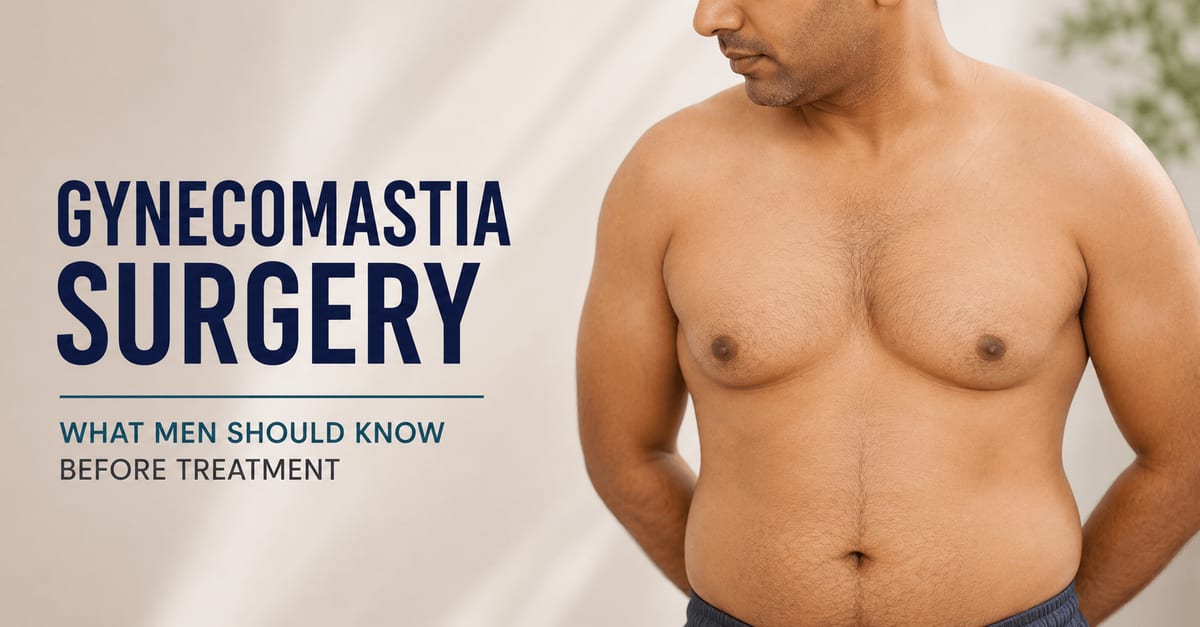
Gynecomastia is the enlargement of male breast tissue.
It occurs because glandular breast tissue develops beneath the nipple.
Unlike ordinary chest fat, glandular tissue usually feels firmer.
It often forms a rubbery or disc-like swelling directly beneath the nipple.
The enlargement may affect:
- One side only
- Both sides equally
- Both sides but with different severity
Many men confuse gynecomastia with excess body fat.
Although both conditions may coexist, they are not the same.
Understanding this difference is essential because treatment options are different.
Gynecomastia vs Chest Fat: What Is the Difference?
One of the biggest misconceptions is believing every enlarged male chest is gynecomastia.
In reality, there are two common possibilities.
Gynecomastia
- Enlarged glandular tissue
- Firm tissue beneath the nipple
- Often persists despite exercise
- May be tender during early stages
Pseudogynecomastia
This refers to excess fat accumulation over the chest.
It is commonly associated with weight gain and obesity.
Unlike glandular enlargement, fatty tissue often improves with:
- Weight loss
- Exercise
- Body fat reduction
Some men have both glandular tissue and excess fat.
During consultation, identifying which component is dominant helps determine the best treatment.
Why Does Gynecomastia Develop?
Gynecomastia develops because of an imbalance between male and female hormones, particularly testosterone and estrogen.
Several factors may contribute.
Puberty
This is the most common cause.
Hormonal changes during adolescence can temporarily enlarge breast tissue.
In many teenagers, the swelling improves naturally over time.
However, in some individuals, the gland persists into adulthood.
Medications
Certain medications may contribute to gynecomastia.
Examples include some medicines used for:
- Blood pressure
- Hormonal disorders
- Prostate conditions
- Mental health disorders
- Certain heart conditions
Patients should never stop prescribed medications without medical advice.
Weight Gain
Excess body fat increases estrogen production.
Obesity can also make gynecomastia more noticeable.
Hormonal Disorders
Less commonly, hormonal conditions affecting the testes, thyroid, adrenal glands, or pituitary gland may contribute.
These situations require proper medical evaluation.
Liver or Kidney Disease
Certain chronic medical conditions may alter hormone metabolism and contribute to breast enlargement.
Use of Anabolic Steroids
Anabolic steroids remain a well-recognised cause of gynecomastia.
Bodybuilders using performance-enhancing drugs may develop persistent glandular enlargement despite having very low body fat.
Sometimes No Clear Cause Is Found
Many healthy men develop gynecomastia without an obvious explanation.
This is called idiopathic gynecomastia.
Can Exercise Cure Gynecomastia?
This is probably the most searched question online.
The answer depends on what is causing the enlarged chest.
If the enlargement is mainly due to excess fat:
Exercise and weight loss may significantly improve chest appearance.
However, if true glandular tissue is present, exercise alone usually cannot remove it.
Many patients tell me,
“I’ve lost 15 kilograms, but my chest still looks the same.”
That is often because glandular tissue remains.
Muscle-building exercises may strengthen the chest muscles, but they cannot eliminate breast gland tissue.
When Should You See a Doctor?
Some men delay consultation for years because they assume nothing can be done.
Others worry about embarrassment.
There is no need to feel uncomfortable.
A medical evaluation is important if you notice:
- Persistent breast enlargement
- One-sided swelling
- Pain or tenderness
- Nipple discharge
- Rapid increase in size
- A hard or irregular lump
- Enlargement lasting beyond adolescence
Although gynecomastia is usually benign, certain symptoms require further evaluation.
How Is Gynecomastia Diagnosed?
Diagnosis begins with a detailed consultation.
I ask about:
- When the swelling began
- Weight changes
- Puberty history
- Medications
- Family history
- Medical conditions
- Exercise habits
- Previous treatments
I then perform a careful examination to determine:
- Glandular tissue
- Fat distribution
- Skin quality
- Chest symmetry
- Nipple position
- Severity of enlargement
In selected patients, blood tests or imaging studies may be recommended to identify underlying causes.
Understanding the Different Grades of Gynecomastia
Gynecomastia is commonly classified into different grades.
Grade 1
Small enlargement without excess skin.
Grade 2
Moderate enlargement.
The chest appears fuller but skin excess is usually minimal.
Grade 3
Larger enlargement with noticeable chest fullness.
Mild skin redundancy may be present.
Grade 4
Significant breast enlargement with excess skin resembling a female breast contour.
Higher grades often require more advanced surgical planning.
Treatment recommendations depend on both the grade and individual anatomy.
When Is Surgery Recommended?
Not every patient requires surgery.
Some adolescents improve naturally.
Others benefit from addressing an underlying medical condition.
However, surgery may be considered when:
- Glandular tissue persists after puberty.
- Exercise has not improved chest contour.
- The enlargement causes emotional distress.
- Weight has stabilised.
- The patient has realistic expectations.
- There is persistent glandular enlargement confirmed on examination.
Surgery aims to create a flatter, more masculine chest contour while preserving natural proportions.
My Philosophy Before Recommending Surgery
One of the most important parts of consultation is understanding the patient—not just the chest.
Some patients need reassurance.
Some need weight management.
Some require hormonal evaluation.
Some genuinely benefit from surgery.
My role is not simply to perform procedures.
It is to recommend the treatment that is medically appropriate and likely to provide lasting benefit.
For some patients, surgery is the best option.
For others, it may not be necessary.
Every recommendation should be individualised.
What Happens During Gynecomastia Surgery?
One of the biggest fears patients have is not the surgery itself—it’s the unknown.
Many ask,
“Doctor, will you remove the entire breast?”
Or,
“Will there be a big scar?”
Modern gynecomastia surgery is far more refined than many people imagine.
The primary goal is to create a flatter, natural-looking masculine chest while preserving the normal contour and nipple appearance.
The exact surgical technique depends on what is causing the enlargement.
Some men have predominantly fatty tissue.
Others have dense glandular tissue.
Many have a combination of both.
This is why every surgery is customised.
Liposuction vs Gland Excision: What’s the Difference?
Patients often hear the word “liposuction” and assume that is the only treatment required.
However, true gynecomastia frequently involves firm glandular tissue that liposuction alone cannot remove.
Liposuction
Liposuction is useful when excess fat contributes significantly to the enlarged chest.
Small incisions are made through which a thin tube (cannula) removes unwanted fat.
It helps improve:
- Chest contour
- Side chest fullness
- Overall definition
Gland Excision
Firm breast gland tissue is usually removed through a small incision placed discreetly along the lower border of the areola (the darker skin surrounding the nipple).
This allows removal of tissue that cannot be treated by liposuction alone.
Combination Surgery
For many patients, the best cosmetic outcome comes from combining:
- Liposuction
- Gland excision
- Careful contouring
The objective is not simply removing tissue.
It is creating a smooth, natural-looking chest without obvious depressions or irregularities.
Is Gynecomastia Surgery Permanent?
This is one of the most frequently searched questions.
In most patients, the glandular tissue removed during surgery does not grow back.
However, long-term results also depend on maintaining a healthy lifestyle.
Factors that may contribute to recurrence include:
- Significant weight gain
- Continued anabolic steroid use
- Untreated hormonal disorders
- Certain medications
- Persistent endocrine abnormalities
For most healthy individuals, surgery provides long-lasting improvement.
Will There Be Scars?
Another common concern is scarring.
Modern gynecomastia surgery uses small, carefully placed incisions.
Whenever possible, scars are hidden:
- Around the edge of the areola
- Within natural skin folds
- In discreet locations used for liposuction
Initially, scars may appear pink or slightly firm.
Over the following months, they generally become flatter and less noticeable.
Good wound care, sun protection, and following your surgeon’s advice help optimise scar healing.
Recovery After Gynecomastia Surgery
Recovery varies between individuals.
Most patients are pleasantly surprised that discomfort is less than expected.
During the First Few Days
You may experience:
- Mild swelling
- Bruising
- Tightness
- Temporary soreness
Pain is usually manageable with prescribed medication.
Compression Garment
Patients are commonly advised to wear a compression garment.
This helps:
- Reduce swelling
- Support healing tissues
- Improve chest contour
- Minimise fluid accumulation
The duration depends on the extent of surgery and your surgeon’s recommendations.
Returning to Daily Activities
Many patients resume desk-based work within a few days.
More strenuous activities such as weight training, heavy lifting, and intense exercise are usually postponed until healing progresses adequately.
Your recovery plan will be individualised.
When Will I See the Final Results?
Immediately after surgery, swelling may temporarily hide the final chest contour.
Most patients notice progressive improvement over several weeks.
As swelling settles:
- Chest becomes flatter
- Contours improve
- Definition becomes more apparent
Final results may continue to evolve over several months as tissues soften and mature.
Patience is important during this period.
Common Myths About Gynecomastia Surgery
Myth 1: Exercise Can Always Cure Gynecomastia
False.
Exercise can reduce body fat.
It cannot remove persistent glandular breast tissue.
Myth 2: Only Overweight Men Develop Gynecomastia
False.
Many lean, athletic men develop gynecomastia because gland enlargement is related to hormones rather than body fat alone.
Myth 3: Surgery Leaves Large Visible Scars
Modern surgical techniques usually involve small, carefully concealed incisions.
Myth 4: Gynecomastia Always Returns
Not true.
Recurrence is uncommon when the gland is appropriately removed and contributing factors are managed.
Myth 5: It Is Just a Cosmetic Problem
While gynecomastia is medically benign in most cases, its psychological impact can be significant.
Many men experience:
- Reduced confidence
- Social anxiety
- Avoidance of sports or swimming
- Difficulty wearing fitted clothing
Improving chest contour often has a positive effect on self-confidence and quality of life.
Who Is a Good Candidate for Surgery?
You may be a suitable candidate if:
- Breast enlargement has persisted beyond puberty.
- Weight has remained relatively stable.
- Exercise has not improved the chest contour.
- You are in good general health.
- You have realistic expectations.
- You understand the recovery process.
A consultation helps determine whether surgery is appropriate for your individual situation.
What Happens During Consultation at Derma Solutions?
Every patient begins with a detailed evaluation.
I discuss:
- Your concerns
- Duration of enlargement
- Weight history
- Exercise habits
- Medication use
- Hormonal history
- Previous treatments
A physical examination helps determine:
- Amount of glandular tissue
- Fat distribution
- Skin quality
- Chest symmetry
- Degree of enlargement
- Suitability for surgery
Where appropriate, investigations may be recommended before planning treatment.
No two patients are identical.
The treatment plan should reflect your anatomy—not a standard formula.
My Advice Before Considering Surgery
If enlarged breast tissue has affected your confidence for years, you do not need to continue living with uncertainty.
However, avoid rushing into surgery based solely on online advertisements.
Choose a qualified surgeon who:
- Performs a thorough examination.
- Explains all treatment options.
- Discusses benefits and limitations honestly.
- Prioritises natural-looking outcomes.
- Focuses on long-term results rather than quick fixes.
A successful surgery is one that restores confidence while maintaining a masculine, proportionate chest.
Frequently Asked Questions
1. Can gynecomastia go away naturally?
Pubertal gynecomastia often resolves on its own.
Persistent enlargement in adults is less likely to disappear without treatment.
2. Can exercise remove gynecomastia?
Exercise can reduce chest fat but generally cannot remove persistent glandular tissue.
3. Is surgery the only permanent treatment?
For persistent glandular gynecomastia, surgery is considered the most definitive treatment.
4. Is gynecomastia surgery painful?
Most patients report only mild to moderate discomfort that is manageable with prescribed medication.
5. How long does surgery take?
The duration varies depending on the severity of enlargement and surgical technique used.
Your surgeon will discuss the expected operative time during consultation.
6. Will there be visible scars?
Scars are usually small and strategically placed around the areola or within natural skin folds.
They generally become less noticeable with time.
7. How long is recovery?
Most patients return to routine daily activities within several days, although strenuous exercise should be resumed only after medical clearance.
8. Can gynecomastia return after surgery?
Recurrence is uncommon but may occur if contributing factors such as anabolic steroid use, significant weight gain, or untreated hormonal disorders persist.
9. Is the surgery permanent?
The glandular tissue removed during surgery is generally permanently removed.
Maintaining a healthy lifestyle helps preserve long-term results.
10. Will I lose nipple sensation?
Temporary changes in sensation may occur during healing.
Permanent changes are uncommon but can occur with any surgical procedure.
Your surgeon will discuss potential risks during consultation.
11. Is gynecomastia surgery safe?
When performed by an experienced surgeon following appropriate patient evaluation, gynecomastia surgery is generally considered safe.
As with all operations, potential risks and complications should be discussed beforehand.
12. At what age can gynecomastia surgery be performed?
Surgery is usually considered after puberty has been completed and breast enlargement has remained stable.
Individual assessment is essential.
13. Can teenagers undergo surgery?
Selected teenagers with persistent, psychologically distressing gynecomastia may be considered after careful evaluation.
14. How do I know whether I need surgery?
A clinical examination by an experienced surgeon is the best way to determine whether your enlarged chest is due to fat, glandular tissue, or both, and whether surgery is the most appropriate treatment.
Final Thoughts
Gynecomastia is far more common than many men realise.
It is also one of the most misunderstood conditions.
Some patients benefit from lifestyle changes.
Others require evaluation for underlying medical conditions.
For men with persistent glandular enlargement, gynecomastia surgery can provide a flatter, more masculine chest contour and significantly improve self-confidence.
At Derma Solutions, my approach is always centred on honest advice, careful evaluation, and personalised treatment planning.
The goal is not simply to remove tissue.
It is to restore confidence while achieving results that look natural and proportionate to your body.
References
- American Society of Plastic Surgeons (ASPS) – https://www.plasticsurgery.org/
- American Society for Aesthetic Plastic Surgery (The Aesthetic Society) – https://www.theaestheticsociety.org/
- NCBI Bookshelf – Gynecomastia: https://www.ncbi.nlm.nih.gov/books/NBK430812/
- StatPearls – Gynecomastia: https://www.ncbi.nlm.nih.gov/books/NBK430812/
- PubMed – Surgical Management of Gynecomastia: https://pubmed.ncbi.nlm.nih.gov/31033816/
Considering Gynecomastia Surgery?
View Treatment