Table of Contents
Introduction
One of the first questions patients ask me before getting dermal fillers is,
“Doctor, how long will my fillers last?”
It’s an important question because dermal fillers are an investment—not just financially, but also in your appearance and confidence.
Dermal fillers have become one of the most sought-after non-surgical cosmetic treatments worldwide because they provide immediate, natural-looking results with little to no downtime. Whether it’s restoring lost facial volume, enhancing the lips, contouring the jawline, or softening deep wrinkles, fillers can subtly rejuvenate the face without surgery.
However, unlike permanent implants, dermal fillers are designed to be temporary. Their longevity depends on several factors, including the type of filler used, the area treated, your metabolism, and your lifestyle.
In this guide, I’ll explain how dermal fillers work, how long they last in different parts of the face, what influences their longevity, and how you can maintain beautiful results safely.
What Are Dermal Fillers?
Dermal fillers are injectable gel-like substances that restore lost volume, smooth wrinkles, improve facial contours, and enhance specific facial features.
As we age, our skin gradually loses:
- Collagen
- Elastin
- Hyaluronic acid
- Facial fat
These natural changes lead to:
- Hollow cheeks
- Fine lines
- Wrinkles
- Thin lips
- Sagging skin
- Loss of facial definition
Dermal fillers help replace this lost volume and restore youthful facial proportions without surgery.
Today, the most commonly used fillers are made from Hyaluronic Acid (HA)—a naturally occurring substance found in our skin that attracts and retains moisture.
The goal isn’t to change how you look but to help you look refreshed, well-rested, and naturally youthful.
How Do Dermal Fillers Work?
Dermal fillers work by adding volume beneath the skin.
Once injected into the targeted area, the filler:
- Restores facial volume
- Smoothens wrinkles
- Improves facial symmetry
- Defines facial contours
- Hydrates the skin
Because hyaluronic acid attracts water molecules, the treated area often appears softer, healthier, and more youthful almost immediately.
Over time, the body gradually breaks down the filler through natural metabolic processes.
This gradual breakdown is why dermal fillers are temporary rather than permanent.
Why Don’t Dermal Fillers Last Forever?
Patients often wonder why fillers dissolve over time.
The answer lies in the body’s natural metabolism.
Hyaluronic acid is naturally present in the skin, and your body continually breaks it down and replaces it.
Injected fillers undergo the same process.
Eventually, enzymes within the body slowly degrade the filler until it is completely absorbed.
The speed of this process varies from person to person.
Some individuals metabolize fillers quickly, while others enjoy longer-lasting results.
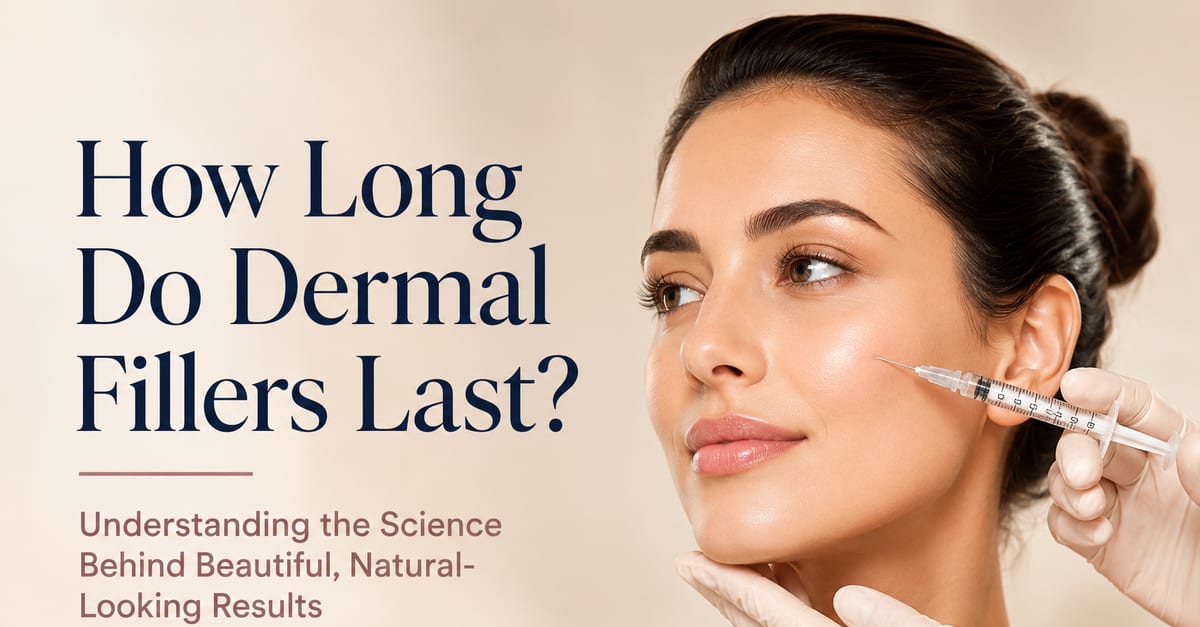
How Long Do Dermal Fillers Last?
The longevity of dermal fillers depends on:
- Type of filler
- Area treated
- Product used
- Individual metabolism
- Lifestyle habits
On average, dermal fillers last between 6 months and 24 months.
Let’s look at different treatment areas.
Lip Fillers
Average duration:
6–12 months
The lips are constantly moving while:
- Talking
- Eating
- Smiling
- Drinking
This frequent movement causes fillers in the lips to dissolve faster than in many other facial areas.
Most patients choose maintenance treatments every 8–10 months.
Cheek Fillers
Average duration:
12–24 months
The cheeks require denser fillers that provide structural support.
Since there is less movement compared to the lips, cheek fillers generally last much longer.
Cheek enhancement also helps improve:
- Mid-face volume
- Nasolabial folds
- Facial balance
Chin Fillers
Average duration:
12–18 months
Chin fillers improve facial profile and definition.
Patients seeking a stronger jawline or improved facial proportions often combine chin fillers with jawline contouring.
Jawline Fillers
Average duration:
12–18 months
Jawline contouring has become increasingly popular among both men and women.
Results typically last over a year because firmer fillers are used in this area.
Under-Eye Fillers
Average duration:
9–18 months
The tear trough area has minimal movement.
As a result, under-eye fillers often last longer than lip fillers.
They help reduce:
- Hollow eyes
- Dark shadows
- Tired appearance
Proper patient selection is essential because not everyone is a suitable candidate for this treatment.
Nose Fillers (Non-Surgical Rhinoplasty)
Average duration:
12–18 months
Dermal fillers can improve:
- Small nasal humps
- Nasal asymmetry
- Flat bridge
Although results are temporary, many patients appreciate the option of enhancing the nose without surgery.
Temple Fillers
Average duration:
12–18 months
Temple hollowing becomes more noticeable with age.
Restoring volume in this area contributes significantly to overall facial rejuvenation.
Smile Lines (Nasolabial Folds)
Average duration:
9–18 months
Fillers soften deep folds between the nose and mouth while preserving natural facial expressions.
Marionette Lines
Average duration:
9–18 months
These lines extend downward from the corners of the mouth.
Treatment restores support and creates a fresher appearance.
What Factors Affect How Long Dermal Fillers Last?
Several factors influence filler longevity.
Type of Filler
Different filler brands have varying densities and formulations.
Some are designed for:
- Lips
- Fine lines
- Deep structural support
- Facial contouring
Higher-density fillers generally last longer.
Treatment Area
Areas with constant movement tend to break down fillers more quickly.
Examples include:
- Lips
- Around the mouth
Areas with less movement often maintain results longer.
Individual Metabolism
People with faster metabolic rates may dissolve fillers sooner.
Athletes and highly active individuals sometimes notice shorter-lasting results.
Lifestyle Habits
Certain habits can influence longevity.
These include:
- Smoking
- Excessive alcohol
- Poor skincare
- Sun exposure
Healthy lifestyle choices support longer-lasting results.
Amount of Filler Used
Very small amounts may naturally disappear sooner.
The right treatment plan balances natural appearance with adequate correction.
Can Dermal Fillers Be Dissolved?
Yes.
One of the biggest advantages of hyaluronic acid fillers is that they are reversible.
If necessary, an enzyme called Hyaluronidase can dissolve the filler safely.
Reasons for dissolving fillers may include:
- Patient preference
- Overcorrection
- Asymmetry
- Rare complications
This provides reassurance for patients considering treatment for the first time.
How Can You Make Dermal Fillers Last Longer?
Although fillers naturally dissolve over time, certain habits can help maintain results.
Follow a Good Skincare Routine
Healthy skin supports better long-term outcomes.
Daily skincare should include:
- Sunscreen
- Moisturizer
- Antioxidants
- Retinoids (when appropriate)
Stay Hydrated
Hyaluronic acid attracts water.
Drinking enough water helps maintain healthy skin hydration.
Protect Your Skin From Sun Damage
UV exposure accelerates collagen breakdown.
Using SPF daily protects both your skin and aesthetic results.
Maintain a Healthy Lifestyle
Balanced nutrition, regular exercise, and adequate sleep contribute to healthier skin aging.
Schedule Maintenance Treatments
Rather than waiting until fillers completely disappear, periodic touch-ups help maintain consistent, natural-looking results.
Are Repeat Treatments Necessary?
Yes.
Since dermal fillers gradually dissolve, maintenance treatments are usually recommended.
However, many patients notice that after repeated treatments, smaller touch-ups may be sufficient because collagen production has improved and facial support has been gradually restored.
The goal is not to overfill the face but to preserve natural facial harmony over time.
Are Dermal Fillers Safe?
When performed by qualified medical professionals using FDA-approved products, dermal fillers have an excellent safety profile.
Before treatment, every patient should undergo a detailed consultation to assess:
- Facial anatomy
- Medical history
- Treatment goals
- Suitability for fillers
Safety should always take priority over achieving dramatic results.
Possible Side Effects
Like any injectable treatment, dermal fillers may cause temporary side effects.
These include:
- Mild swelling
- Redness
- Bruising
- Tenderness
- Minor discomfort
These effects usually resolve within a few days.
Serious complications are uncommon but highlight the importance of choosing an experienced injector who understands facial anatomy.
Dermal Fillers vs Botox
Many patients confuse fillers with Botox, but they serve different purposes.
| Dermal Fillers | Botox |
|---|---|
| Restore lost volume | Relax facial muscles |
| Enhance lips and cheeks | Treat forehead lines |
| Contour jawline and chin | Reduce crow’s feet |
| Immediate volume restoration | Smooth dynamic wrinkles |
| Last 6–24 months | Last 3–6 months |
In many cases, combining both treatments provides the most balanced and natural facial rejuvenation.
Common Myths About Dermal Fillers
Myth 1: Fillers Make You Look Fake
False.
When performed correctly, dermal fillers should enhance your natural features—not change them.
Myth 2: Bigger Is Better
False.
The best aesthetic results are subtle and proportionate.
Myth 3: Fillers Stretch the Skin
False.
When administered appropriately, fillers do not permanently stretch the skin.
Myth 4: Fillers Are Only for Older People
False.
Many younger patients choose fillers for lip enhancement, facial balancing, or chin definition.
Myth 5: Results Last Forever
False.
Dermal fillers gradually dissolve and require maintenance.
My Approach to Dermal Fillers at Derma Solutions
At Derma Solutions, my philosophy is simple:
Less is often more.
Every treatment begins with a detailed facial assessment to understand your unique anatomy, facial proportions, and aesthetic goals. Rather than following trends or creating exaggerated features, I focus on restoring balance, enhancing natural beauty, and delivering results that are elegant, subtle, and age-appropriate.
Whether you are considering lip enhancement, cheek contouring, jawline definition, or full-face rejuvenation, the treatment plan is always customized to suit your face—not someone else’s.
Final Thoughts
Dermal fillers have transformed aesthetic medicine by offering a safe, minimally invasive way to restore youthful facial contours without surgery.
While results are temporary, they can last anywhere from 6 months to 2 years, depending on the treatment area, product used, and individual factors. Choosing the right filler, maintaining a healthy lifestyle, and scheduling periodic touch-ups can help you enjoy long-lasting, natural-looking results.
The most successful filler treatments are those that enhance your confidence while preserving your individuality. A refreshed appearance should never look artificial—it should simply help you look like the best version of yourself.
If you are considering dermal fillers and would like to understand which treatment is right for your facial features and aesthetic goals, a personalized consultation is the first step toward achieving beautiful, balanced, and natural-looking results.
References
- American Society of Plastic Surgeons (ASPS) – Dermal Fillers
ASPS – Dermal Fillers - American Academy of Dermatology (AAD) – Soft Tissue Fillers
American Academy of Dermatology – Soft Tissue Fillers - Mayo Clinic – Dermal Fillers: Benefits, Risks and Expectations
Mayo Clinic – Dermal Fillers Guide - Cleveland Clinic – Dermal Fillers: Procedure and Results
Cleveland Clinic – Dermal Fillers - U.S. Food & Drug Administration (FDA) – Dermal Fillers: What You Should Know
FDA – Dermal Fillers Information