
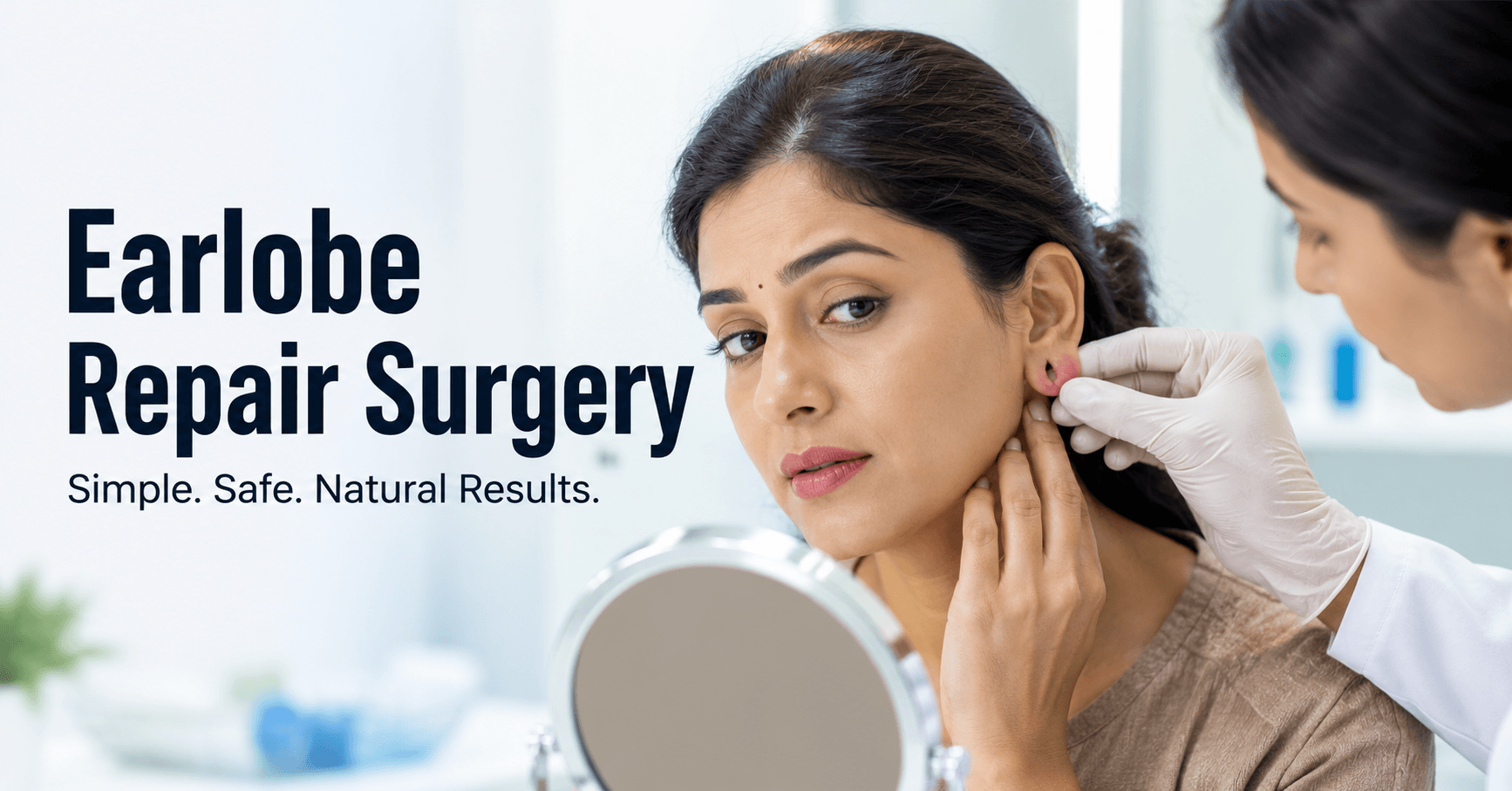
A torn earlobe may seem like a small problem.
But for many people, it affects confidence far more than they expect.
Patients often tell me,
“Doctor, my earring suddenly pulled through.”
Or,
“I’ve stopped wearing earrings because my piercing has become too large.”
Some say,
“I avoided repairing it for years because I thought surgery would be painful.”
These are concerns I hear frequently at Derma Solutions in Marathahalli, Bengaluru.
Women are the most common patients, but men also seek treatment after trauma, accidents, or stretched ear piercings.
Fortunately, earlobe repair surgery is one of the simplest cosmetic surgical procedures we perform.
It is:
Most importantly, patients are often surprised by how natural their repaired earlobe looks after healing.
If you have a torn, stretched, split, or damaged earlobe, understanding the procedure can help you make an informed decision.
The earlobe is made mostly of skin and fatty tissue.
Unlike the upper ear, it does not contain cartilage.
Although soft and flexible, the earlobe is vulnerable to stretching and tearing because earrings constantly pull downward due to gravity.
The most common causes include:
Large traditional earrings worn over many years gradually stretch the piercing hole.
Eventually, the hole becomes elongated or completely splits.
Sometimes an earring catches on:
The sudden pull can tear the earlobe instantly.
As we age, skin naturally loses collagen and elasticity.
Older earlobes become thinner and more prone to stretching.
Fashion trends involving large ear gauges intentionally stretch the earlobe.
Some patients later decide they want their natural earlobe restored.
Piercings placed too close to the edge of the earlobe leave very little supporting tissue.
Even lightweight earrings may eventually cause splitting.
Not every damaged earlobe looks the same.
Understanding the type of tear helps determine the best repair technique.
The piercing has elongated but remains connected.
The hole appears larger than normal.
Patients often notice earrings hanging lower than before.
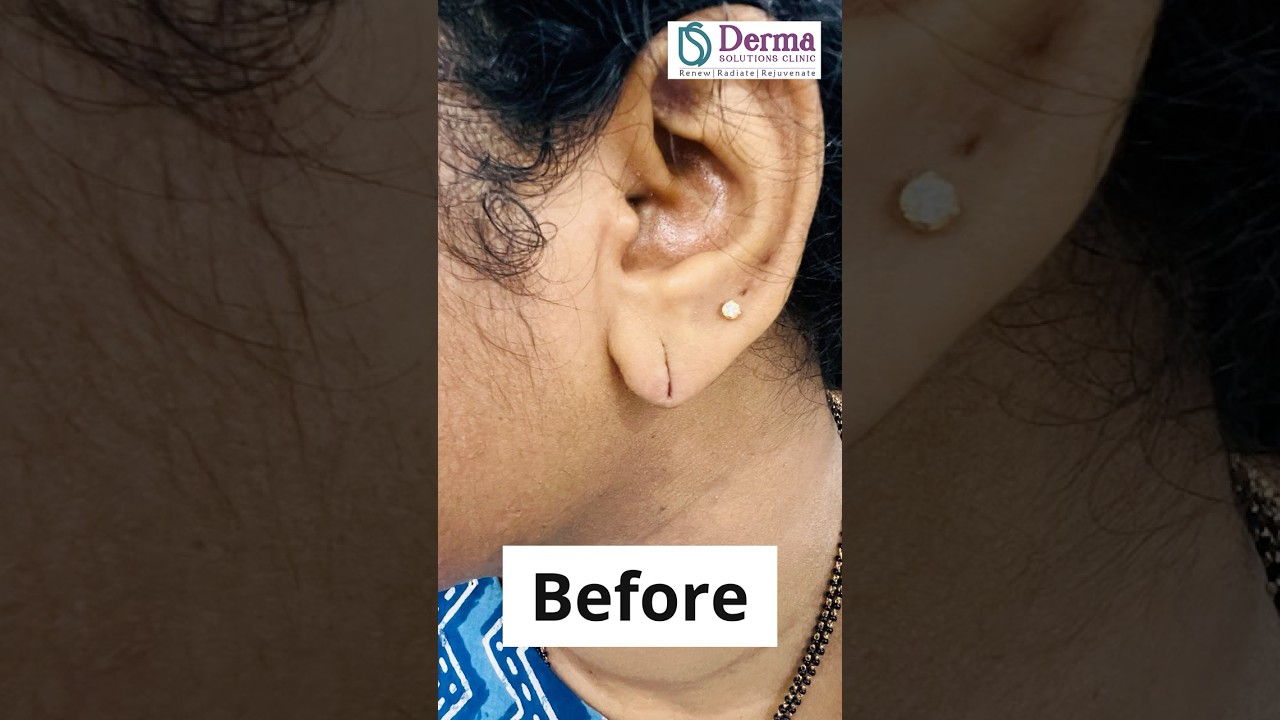
The piercing has completely torn through the lower edge.
The earlobe becomes divided into two parts.
This usually requires surgical repair.
The hole becomes enlarged over time.
It may not be completely torn but is often too large for earrings to sit properly.
Large intentional stretching may leave a circular defect that cannot shrink on its own.
Surgery is usually required for cosmetic restoration.
Some patients develop several stretched or torn piercings on the same ear.
These can often be corrected during a single procedure.
This is one of the most frequently asked questions.
Unfortunately, the answer is usually no.
Unlike a small skin cut, a split earlobe rarely rejoins by itself.
Once the edges have healed separately, surgery is generally needed to restore the normal shape.
Delaying treatment does not usually improve the appearance.
In fact, repeated trauma may make the tear worse over time.
Earlobe repair surgery is a minor cosmetic surgical procedure that restores the natural shape of the earlobe.
The damaged tissue is carefully removed.
Fresh skin edges are created.
The earlobe is then precisely stitched back together to recreate a smooth, natural contour.
Because the procedure focuses on both function and appearance, careful surgical planning is essential.
The goal is not simply closing the tear.
The goal is making the repair as inconspicuous as possible after healing.
Most healthy adults are suitable candidates.
You may benefit from surgery if you have:
The best candidates have realistic expectations and understand that healing takes several weeks.
Before recommending surgery, I perform a detailed examination of both ears.
During consultation we discuss:
Some patients want the piercing recreated.
Others prefer a completely closed earlobe.
Every treatment plan is personalised.
One reason patients appreciate this procedure is its simplicity.
It is usually performed in the clinic under local anaesthesia.
The general steps include:
The ear is cleaned thoroughly.
Local anaesthetic is administered to numb the area.
Patients remain awake but comfortable throughout the procedure.
The damaged edges are carefully refreshed.
This allows healthy skin edges to heal together properly.
The earlobe is meticulously reconstructed using fine sutures.
Particular attention is given to maintaining symmetry and preserving the natural curve of the earlobe.
A small dressing may be applied before the patient goes home.
The entire procedure usually takes 30–60 minutes, depending on the complexity of the repair.
Patients can return home shortly afterward.
This is probably the question I hear most often.
The answer is reassuring.
Because local anaesthesia is used, patients generally do not feel pain during the procedure.
After surgery, mild soreness or tenderness may occur for a few days.
Most patients find this manageable with the medications prescribed by their doctor.
Every surgical procedure leaves a scar.
However, in earlobe repair, the scar is usually very fine and blends well with the natural contour of the ear over time.
Good surgical technique, proper wound care, and following post-operative instructions all contribute to a better cosmetic outcome.
Although earlobe repair is considered a minor procedure, achieving a natural-looking result requires precision.
Poorly aligned repairs can lead to:
Careful planning and meticulous closure help restore both appearance and function.
At Derma Solutions, my focus is not just repairing the tear but recreating an earlobe that looks balanced and natural.
One of the biggest advantages of earlobe repair surgery is the relatively quick recovery.
Because it is a minor outpatient procedure performed under local anaesthesia, most patients can return to their routine activities on the same day or the following day.
However, healing is a gradual process.
The appearance of the earlobe improves week by week.
Understanding what to expect helps patients recover with confidence.
During the first couple of days, you may notice:
These symptoms are completely normal and usually improve quickly.
Most patients only require simple pain medication for a day or two.
The earlobe begins to heal steadily.
It is important to:
Most people feel comfortable returning to work, office meetings, or social activities within a day or two.
Depending on the type of sutures used, stitches are generally removed after 7 to 14 days.
Your doctor will assess healing before removing them.
The procedure is quick and usually causes minimal discomfort.
Although the skin heals within a few weeks, scar maturation takes longer.
Over several months, the scar gradually becomes:
Proper scar care and sun protection help achieve the best cosmetic outcome.
Good aftercare is just as important as the surgery itself.
Following simple precautions can significantly improve the final appearance.
Follow the cleaning instructions provided by your dermatologist or surgeon.
Avoid applying unapproved creams or home remedies.
Do not wear earrings during the healing period.
Avoid sleeping directly on the operated ear if possible.
Avoid swimming pools, hot tubs, or activities that may expose the wound to contamination until healing is complete.
Regular follow-up allows your doctor to monitor healing and identify any concerns early.
Good cosmetic results take time.
Do not judge the final appearance during the first few weeks.
This is one of the most common questions patients ask.
The answer depends on individual healing.
In most cases, re-piercing is considered after approximately 6 to 12 weeks, once the repaired tissue has healed adequately.
The new piercing should not be placed directly through the surgical scar.
Instead, it is usually positioned slightly away from the repaired area to reduce the risk of future tearing.
Your dermatologist will advise the most appropriate timing and placement.
Yes.
Even after successful surgery, another tear is possible if the earlobe is subjected to excessive stress.
The good news is that recurrence can often be prevented.
Simple habits can protect your repaired earlobes for years.
Heavy earrings are one of the leading causes of recurrent stretching.
Reserve heavier jewellery for occasional use.
Sleeping with earrings increases the chance of accidental pulling.
Young children may unintentionally grab earrings, causing sudden tears.
Take extra care while changing clothes, wearing scarves, helmets, or face masks.
Never rush to wear earrings before your doctor confirms complete healing.
Earlobe repair surgery has a high success rate when performed by an experienced dermatologist or cosmetic surgeon.
However, like any surgical procedure, there are potential risks.
These may include:
Fortunately, these complications are uncommon when proper surgical technique and aftercare are followed.
Absolutely.
Many patients choose to repair both ears during the same appointment.
This is especially common when:
Repairing both ears together often provides a more balanced cosmetic outcome.
Yes.
Although women represent the majority of patients, many men seek earlobe repair for:
The surgical technique remains largely the same regardless of gender.
Not always.
While many patients seek treatment for aesthetic reasons, repairing a torn earlobe can also improve function.
Patients often find it easier to:
For many people, restoring the natural appearance of the ear has a positive psychological impact.
Every earlobe is different.
Some tears are recent.
Others have existed for years.
Some involve simple stretched piercings.
Others require more detailed reconstruction.
During consultation, I carefully evaluate:
My objective is not simply to close the tear.
The goal is to restore an earlobe that looks natural, balanced, and proportionate to the face.
Whenever possible, I also discuss preventive measures to minimise the risk of future tearing.
In most cases, no.
Once the edges have healed separately, surgery is usually required to restore the normal shape.
The procedure is performed under local anaesthesia.
Patients generally experience little or no pain during surgery, with only mild discomfort afterward.
Most uncomplicated repairs are completed within 30 to 60 minutes.
A fine scar is expected, but it usually fades significantly over time and blends with the natural contour of the earlobe.
Most patients resume normal daily activities within one or two days.
Yes.
Re-piercing is usually performed after complete healing, typically around 6–12 weeks, depending on individual recovery.
Yes.
Enlarged or elongated piercing holes can often be surgically corrected.
Many stretched or gauged earlobes can be reconstructed surgically after proper evaluation.
The repair is designed to be long-lasting.
However, heavy earrings or new trauma can cause another tear.
In selected cases, children with traumatic tears may undergo repair after appropriate medical assessment.
No.
The procedure is usually performed as a day-care outpatient treatment.
Yes.
Many patients choose to have both ears repaired during the same visit.
Smoking may delay wound healing.
Patients are generally advised to avoid smoking before and after surgery whenever possible.
Your doctor will provide individual instructions, but gentle hair washing is often possible after the first day while keeping the wound protected.
If your piercing has completely split, the hole has become excessively stretched, or the appearance of your earlobe concerns you, a consultation with a qualified dermatologist or dermatosurgeon can determine whether surgical repair is appropriate.
A torn or stretched earlobe may seem like a minor concern, but it can significantly affect appearance and confidence.
Fortunately, earlobe repair surgery is a straightforward procedure with excellent cosmetic outcomes when performed carefully.
Whether your earlobe was damaged by heavy earrings, trauma, ageing, or stretched piercings, timely treatment can restore both appearance and function.
At Derma Solutions, Marathahalli, Bengaluru, my approach focuses on precision, natural-looking reconstruction, and personalised care.
The aim is simple:
Restore your earlobe with minimal scarring, preserve its natural contour, and help you feel confident wearing earrings again if you choose.

Written by: Dr. Sandeep Mahapatra
Senior Dermatologist, Hair Transplant Surgeon & Founder – Derma Solutions Skin & Hair Clinic, Bangalore. | Dr. Sandeep Mahapatra is a senior dermatologist and hair transplant surgeon in Bangalore with extensive experience in dermatology, aesthetic treatments and hair restoration. As the founder of Derma Solutions Skin and Hair Clinic – Marathahalli, Bangalore , With extensive experience in aesthetic dermatology, he has performed 50,000+ laser hair removal treatments, 40,000+ chemical peels, 4,000+ Botox procedures, 2,000+ dermal filler treatments, and 3,000+ vitiligo treatments, helping patients achieve safe, natural-looking, and evidence-based skin and facial rejuvenation results.
Medically reviewed by: Dr. Sandeep Mahapatra
Senior Dermatologist & Hair Transplant Surgeon
Date Reviewed: 2026-07-08
This article has been medically reviewed by Dr. Sandeep Mahapatra to ensure Blog Author & Medical Reviewer