Table of Contents
Body contouring has evolved significantly over the past decade. While maintaining a healthy lifestyle through proper nutrition and regular exercise remains the foundation of good health, many individuals continue to struggle with stubborn pockets of fat that simply refuse to disappear. These localized fat deposits can affect body proportions, confidence, and the way clothes fit, despite dedicated efforts to lose weight.
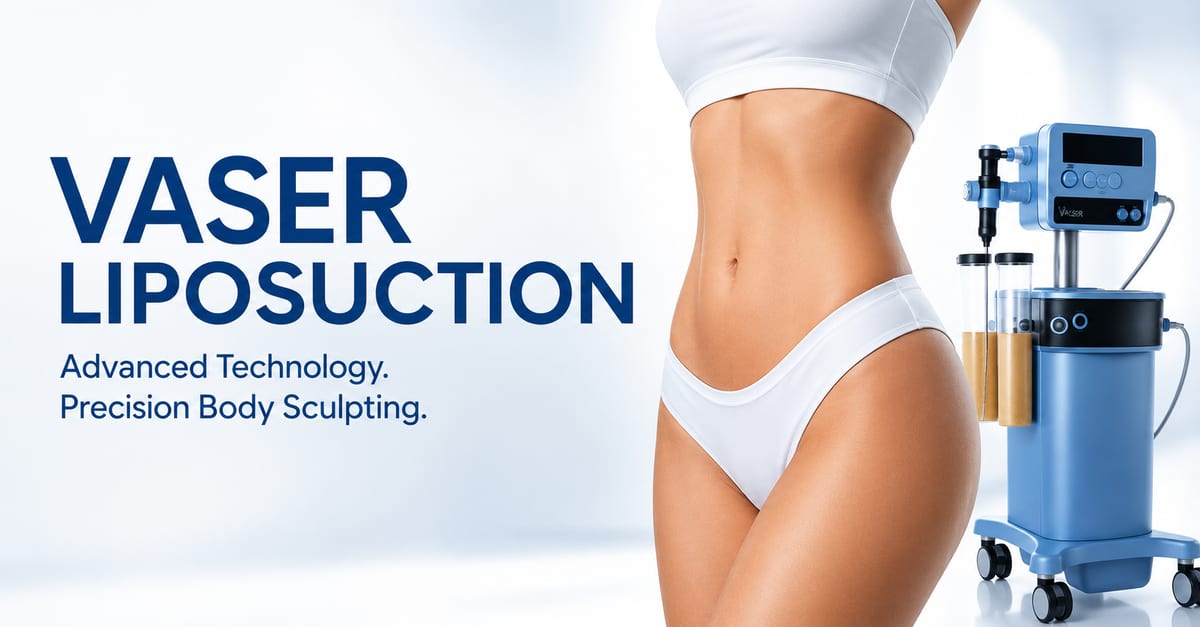
This is where VASER Liposuction has transformed the field of cosmetic surgery. Unlike conventional liposuction techniques, VASER Liposuction uses advanced ultrasound technology to selectively target and remove unwanted fat while preserving surrounding tissues. The result is smoother body contours, improved precision, and a quicker recovery for many patients.
As a cosmetic surgeon, I frequently meet patients who are curious about VASER Liposuction but are unsure whether it is the right option for them. Some believe it is a weight-loss procedure, while others assume it can replace exercise or instantly deliver a perfect body. Understanding what VASER Liposuction can—and cannot—do is essential before making a decision.
In this guide, I will explain everything you need to know about VASER Liposuction, including how it works, who is an ideal candidate, the procedure, recovery, benefits, risks, and realistic expectations.
What Is VASER Liposuction?
VASER stands for Vibration Amplification of Sound Energy at Resonance. It is an advanced liposuction technology that uses ultrasonic energy to gently break apart fat cells before they are removed from the body.
Unlike traditional liposuction, which mechanically separates fat from surrounding tissues, VASER technology emulsifies fat using ultrasound waves. This allows the surgeon to remove fat with greater precision while minimizing trauma to nearby blood vessels, nerves, and connective tissues.
The result is:
- More precise fat removal
- Better body sculpting
- Reduced bruising and swelling
- Smoother body contours
- Faster recovery in many patients
It is important to understand that VASER Liposuction is a body contouring procedure, not a weight-loss surgery. It is designed to improve body shape by removing stubborn fat deposits that remain despite healthy lifestyle habits.
How Does VASER Liposuction Work?
The procedure involves several carefully planned steps.
Step 1: Consultation
Every successful cosmetic procedure begins with a detailed consultation. During this stage, your surgeon evaluates:
- Medical history
- Overall health
- Skin quality
- Fat distribution
- Body proportions
- Cosmetic goals
Photographs may be taken for planning and comparison after recovery.
Step 2: Marking the Treatment Areas
Before surgery, the targeted fat deposits are marked while you are standing. This helps the surgeon achieve balanced and natural body contours.
Step 3: Local or General Anaesthesia
Depending on the number of treatment areas and the amount of fat being removed, the procedure may be performed under local anaesthesia with sedation or general anaesthesia.
Step 4: Ultrasound-Assisted Fat Emulsification
A small probe delivers ultrasonic energy into the fatty tissue.
The ultrasound waves selectively loosen fat cells while preserving nearby structures such as:
- Blood vessels
- Connective tissue
- Nerves
- Skin support structures
This selective approach is one of the reasons VASER Liposuction is associated with less tissue trauma compared to traditional methods.
Step 5: Fat Removal
Once the fat has been emulsified, it is gently suctioned out using fine cannulas.
Since the fat is already liquefied, the removal process requires less force, allowing for smoother contouring and greater precision.
Step 6: Compression Garments
After surgery, patients are advised to wear specially designed compression garments.
These garments help:
- Reduce swelling
- Support healing tissues
- Improve skin adaptation
- Enhance final contouring results
Which Areas Can Be Treated?
One of the biggest advantages of VASER Liposuction is its versatility. It can be used to sculpt multiple areas of the body.
Common treatment areas include:
Abdomen
One of the most frequently treated areas. VASER Liposuction helps remove stubborn abdominal fat to create a flatter and more defined appearance.
Waist and Love Handles
Fat around the waist often remains resistant to diet and exercise. VASER allows for improved waist definition and a more balanced silhouette.
Thighs
Both the inner and outer thighs can be reshaped to improve body proportions and reduce rubbing between the thighs.
Arms
Many patients seek treatment for excess upper arm fat, particularly when diet and exercise have not been effective.
Back
Back fat around the bra line or lower back can be effectively reduced to improve clothing fit and body contours.
Chin and Neck
VASER Liposuction is highly effective for reducing a double chin and improving jawline definition.
Chest (Men)
In suitable patients with gynecomastia, VASER Liposuction may help remove excess fatty tissue to create a more masculine chest contour.
Hips
Localized fat around the hips can be sculpted for improved body symmetry.
Knees and Calves
Selected patients may benefit from contouring these smaller areas to enhance overall leg proportions.
Benefits of VASER Liposuction
Greater Precision
The ultrasound-assisted technology enables surgeons to remove fat more accurately, especially in delicate areas requiring detailed sculpting.
Less Trauma to Surrounding Tissues
Because VASER selectively targets fat cells, surrounding blood vessels and connective tissues experience less damage.
This often contributes to:
- Reduced bruising
- Less bleeding
- Lower postoperative discomfort
Improved Skin Retraction
One of the commonly discussed benefits of VASER technology is its potential to encourage better skin contraction compared to conventional liposuction in appropriately selected patients.
However, skin quality varies from person to person, and patients with significant skin laxity may still require additional procedures such as a tummy tuck or body lift.
More Natural Contours
VASER technology allows for smoother transitions between treated and untreated areas, reducing the risk of irregular contours.
High-Definition Body Sculpting
In experienced hands, VASER Liposuction can be used for advanced body sculpting techniques that enhance natural muscle definition in selected patients.
Faster Recovery
Although recovery varies for every individual, many patients experience:
- Less swelling
- Reduced bruising
- Earlier return to routine activities
compared to traditional liposuction.
Who Is an Ideal Candidate?
VASER Liposuction delivers the best results in carefully selected patients.
You may be a good candidate if you:
- Are close to your ideal body weight
- Have stubborn localized fat deposits
- Have good skin elasticity
- Maintain a healthy lifestyle
- Have realistic expectations
- Are in good general health
- Do not smoke, or are willing to stop smoking before surgery
Who May Not Be a Suitable Candidate?
VASER Liposuction is not recommended for everyone.
It may not be appropriate for individuals who:
- Are significantly overweight or obese
- Expect major weight loss from the procedure
- Have uncontrolled diabetes or serious medical conditions
- Have severe skin laxity requiring skin excision
- Are pregnant or breastfeeding
- Have unrealistic cosmetic expectations
During consultation, your surgeon will recommend the safest and most appropriate treatment based on your individual needs.
Is VASER Liposuction a Weight-Loss Procedure?
This is one of the most common misconceptions.
The answer is No.
VASER Liposuction is not designed to treat obesity.
Instead, it helps remove localized fat deposits that remain despite healthy eating and regular physical activity.
Patients who continue to maintain a balanced diet and exercise routine after surgery are more likely to enjoy long-lasting results.
Recovery After VASER Liposuction
Recovery is a gradual process, and every patient heals at a different pace depending on the treatment areas, the amount of fat removed, overall health, and adherence to post-operative instructions.
One of the advantages of VASER Liposuction is that it generally causes less trauma to surrounding tissues compared to conventional liposuction. However, it is still a surgical procedure, and adequate recovery time is essential for optimal results.
Immediately After Surgery
Following the procedure, you may experience:
- Mild to moderate swelling
- Bruising
- Temporary numbness
- Soreness similar to an intense workout
- Drainage of tumescent fluid from the small incision sites
These symptoms are expected and usually improve over the following days.
You will also be fitted with a compression garment, which plays an important role in reducing swelling, supporting healing tissues, and helping the skin adapt to its new contours.
The First Week
Most patients are encouraged to begin walking within 24 hours of surgery. Gentle movement helps improve circulation and reduces the risk of complications such as blood clots.
During this period, you should:
- Take prescribed medications as directed.
- Stay well hydrated.
- Avoid strenuous activities.
- Wear your compression garment as advised.
- Attend scheduled follow-up appointments.
Many individuals who have desk-based jobs can resume work within a few days to a week, depending on the extent of the procedure and their surgeon’s recommendations.
Weeks Two to Four
As swelling gradually decreases, the body’s new contours begin to emerge.
During this stage:
- Bruising continues to fade.
- Discomfort significantly reduces.
- Light exercise may be resumed after medical clearance.
- Compression garments may still need to be worn.
Patients often notice visible improvements, although the body is still healing internally.
One to Three Months
By this stage:
- Most swelling has subsided.
- Skin continues adapting to the new body contours.
- Results become increasingly noticeable.
- Patients usually return to their full exercise routine after approval from their surgeon.
Three to Six Months
The final body shape becomes more apparent as residual swelling resolves completely.
The body continues refining its appearance over several months, and patience is essential throughout this process.
What Results Can You Expect?
VASER Liposuction is designed to enhance body proportions rather than create an entirely different physique.
Patients commonly notice improvements such as:
- Better waist definition
- A flatter abdomen
- More sculpted thighs and arms
- Improved jawline definition
- Better fitting clothes
- Enhanced body confidence
The results appear gradually as swelling decreases.
Many patients begin seeing noticeable changes within four to six weeks, while final outcomes may take three to six months to fully develop.
Are the Results Permanent?
The fat cells removed during VASER Liposuction are permanently eliminated from the treated areas.
However, maintaining the results depends largely on your lifestyle.
If significant weight gain occurs after surgery, the remaining fat cells in both treated and untreated areas can enlarge, affecting your body contour.
To preserve your results:
- Maintain a balanced diet.
- Exercise regularly.
- Stay hydrated.
- Avoid major fluctuations in body weight.
- Follow a healthy lifestyle.
VASER Liposuction should be viewed as a complement to healthy living—not a replacement for it.
Possible Risks and Complications
Like any surgical procedure, VASER Liposuction carries certain risks. Although complications are uncommon when performed by a qualified and experienced cosmetic surgeon, patients should be aware of potential issues.
These may include:
- Swelling
- Bruising
- Temporary numbness
- Infection
- Fluid accumulation (seroma)
- Bleeding
- Contour irregularities
- Skin laxity
- Pigmentation changes around incision sites
- Rare reactions to anaesthesia
Careful patient selection, meticulous surgical technique, and proper post-operative care help minimise these risks.
Choosing a board-certified cosmetic or plastic surgeon with experience in body contouring is one of the most important steps in ensuring a safe outcome.
How to Prepare for VASER Liposuction
Preparation begins several weeks before surgery.
Your surgeon may advise you to:
- Undergo routine blood investigations.
- Review your current medications.
- Stop smoking well in advance of surgery.
- Avoid certain medications and supplements that increase bleeding risk.
- Arrange transportation home after surgery.
- Prepare a comfortable recovery area.
- Maintain good hydration and nutrition.
Following these instructions carefully contributes to a smoother recovery.
Common Myths About VASER Liposuction
Myth 1: It Is a Weight-Loss Surgery
Reality: VASER Liposuction is a body contouring procedure intended to remove stubborn, localized fat deposits—not to treat obesity.
Myth 2: Fat Will Never Return
Reality: Removed fat cells do not grow back, but remaining fat cells can enlarge if you gain significant weight.
Myth 3: Results Are Immediate
Reality: While some improvement is visible early, swelling must settle before the final results become apparent.
Myth 4: It Tightens Excess Skin in Everyone
Reality: VASER may support better skin retraction in suitable candidates, but it cannot correct significant skin laxity. Additional procedures may be required for excess loose skin.
Myth 5: Recovery Is Instant
Reality: Recovery is often quicker than traditional liposuction, but your body still needs time to heal properly.
Choosing the Right Surgeon Matters
The success of VASER Liposuction depends not only on advanced technology but also on the surgeon’s expertise.
An experienced cosmetic surgeon understands:
- Body proportions
- Surgical safety
- Fat distribution
- Aesthetic balance
- Natural-looking contouring
Every patient is unique, and treatment should always be personalised rather than following a one-size-fits-all approach.
During your consultation, ask questions about your surgeon’s experience, discuss realistic expectations, and ensure you understand the benefits, limitations, recovery, and possible risks before proceeding.