
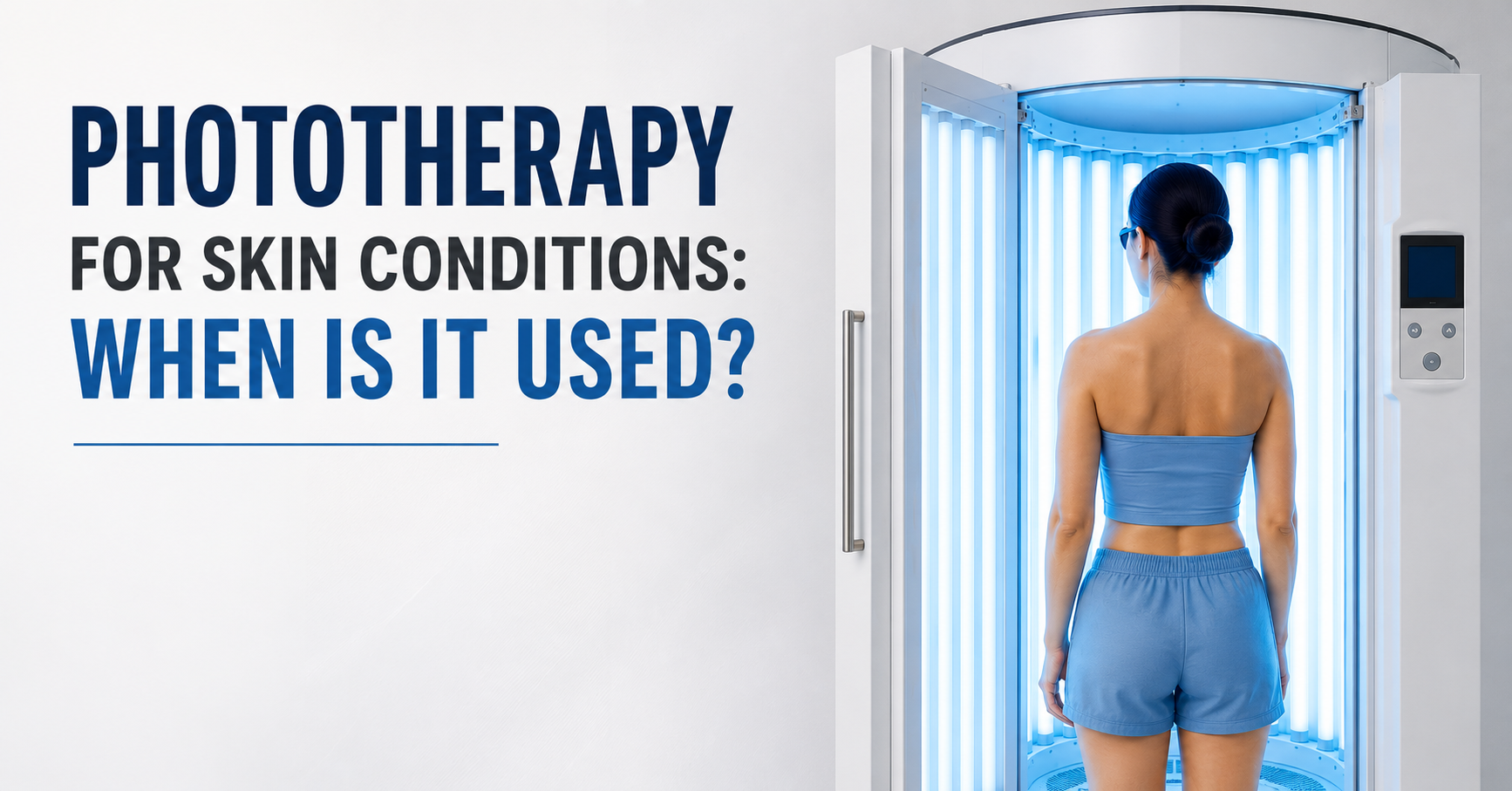
When most people think about treating skin diseases, they imagine creams, ointments, tablets, or cosmetic procedures. However, modern dermatology offers another highly effective treatment option that has been transforming the lives of patients with chronic skin conditions for decades—phototherapy.
One of the most common questions patients ask me is:
“Doctor, is phototherapy just exposing the skin to sunlight?”
The answer is no.
Although sunlight contains ultraviolet (UV) rays, medical phototherapy is a carefully controlled treatment that uses specific wavelengths of ultraviolet light under the supervision of a dermatologist. Unlike natural sunlight, medical phototherapy delivers precise doses of UV light to maximize treatment benefits while minimizing potential risks.
As an MD Dermatologist, I often recommend phototherapy for patients who have not responded adequately to topical medications or those with widespread skin conditions where creams alone may not be practical.
Phototherapy has been used successfully for decades to treat conditions such as psoriasis, vitiligo, eczema, lichen planus, chronic itching, and several other inflammatory skin disorders.
In this article, I’ll explain what phototherapy is, how it works, the different types available, and which patients are most likely to benefit from this evidence-based treatment.
Phototherapy is a medical treatment that uses carefully controlled ultraviolet (UV) light to treat various skin conditions.
Unlike sunlight, which contains multiple wavelengths including harmful UV radiation, phototherapy devices emit specific wavelengths that have been extensively studied for their therapeutic effects.
The treatment is performed using specially designed phototherapy chambers or targeted devices under medical supervision.
Each treatment session is carefully calculated based on:
Because every patient responds differently, the treatment protocol is always personalized.
To understand phototherapy, it helps to first understand why many chronic skin diseases develop.
Conditions such as psoriasis, vitiligo, and eczema involve abnormalities in the immune system or skin cell function.
For example:
Phototherapy works by influencing these biological processes.
Ultraviolet light helps:
Because it targets the underlying disease process rather than simply controlling symptoms, phototherapy can provide long-lasting improvement for many patients.
Some patients wonder whether simply spending more time in the sun can provide the same benefits.
Unfortunately, the answer is no.
Natural sunlight:
Medical phototherapy, on the other hand:
This makes phototherapy significantly safer and more predictable than self-directed sun exposure.
Modern dermatology uses several forms of phototherapy depending on the skin condition being treated.
Narrowband UVB is currently the most commonly used form of phototherapy worldwide.
It emits ultraviolet light at approximately 311–313 nanometres, which has been shown to provide excellent therapeutic benefit while minimizing unwanted side effects.
NB-UVB is commonly used for:
Because of its excellent safety profile, NB-UVB has become the preferred treatment for many inflammatory skin conditions.
Broadband UVB was one of the earlier forms of phototherapy.
It uses a broader spectrum of ultraviolet B wavelengths.
Although still available in some centers, Broadband UVB has largely been replaced by Narrowband UVB because NB-UVB generally provides:
PUVA stands for:
Psoralen + Ultraviolet A
In this treatment, patients receive a medication called psoralen, either orally or topically.
Psoralen makes the skin temporarily more sensitive to ultraviolet A (UVA) light.
After taking psoralen, controlled UVA exposure is administered.
PUVA may be recommended for:
Because PUVA involves photosensitizing medication, additional precautions such as eye protection are necessary.
UVA1 is a specialized form of phototherapy used less commonly but particularly useful for selected conditions.
It penetrates deeper into the skin than UVB.
UVA1 may be recommended for:
Not every dermatology center offers UVA1 therapy because it requires specialized equipment.
Phototherapy is useful for a wide variety of dermatological conditions.
However, treatment recommendations depend on disease severity, previous treatments, and the patient’s overall health.
Let’s look at some of the most common conditions.
Psoriasis is one of the most common conditions treated with phototherapy.
In psoriasis, the immune system triggers rapid skin cell production.
Instead of renewing every few weeks, skin cells accumulate rapidly, leading to:
Phototherapy helps by slowing excessive skin cell growth and reducing inflammation.
Patients with moderate psoriasis often notice significant improvement after several weeks of regular treatment.
In some cases, phototherapy also reduces the need for long-term systemic medications.
Vitiligo occurs when melanocytes, the cells responsible for producing skin pigment, are destroyed.
Phototherapy—particularly Narrowband UVB—is considered one of the most effective treatments for generalized vitiligo.
Treatment works by:
Results vary depending on:
Areas such as the face often respond better than the hands and feet.
Patients with chronic eczema frequently experience:
When topical creams and moisturizers are insufficient, phototherapy may be considered.
UV light helps reduce:
Many patients experience fewer flare-ups after completing a course of treatment.
Lichen planus is an inflammatory skin condition that can cause:
For patients with widespread disease, Narrowband UVB may significantly improve symptoms while reducing itching and inflammation.
Persistent itching without adequate relief from medications can greatly affect quality of life.
Phototherapy may help reduce itching associated with:
Many patients experience gradual improvement after multiple sessions.
Cutaneous T-cell lymphoma (CTCL) is a rare type of skin lymphoma.
In selected early-stage cases, phototherapy can play an important role in treatment by helping control abnormal immune cells within the skin.
Management is always individualized and performed under specialist supervision.
No.
In carefully selected cases, phototherapy may also be recommended for children with conditions such as:
Because children’s skin requires special consideration, treatment is always carefully monitored by a dermatologist.
One of the biggest concerns patients have before starting phototherapy is not knowing what to expect.
Fortunately, the procedure is simple, painless, and does not require hospitalization.
Before your first treatment, your dermatologist will carefully evaluate:
Based on this assessment, an appropriate starting dose of ultraviolet light is selected.
During treatment, you’ll be asked to stand inside a specially designed phototherapy chamber or, in some cases, a targeted phototherapy device may be used for localized areas.
The session itself usually lasts only a few seconds to a few minutes, depending on your prescribed dose.
As treatment progresses, the exposure time is gradually increased according to your skin’s response.
The procedure is painless, and patients generally do not experience discomfort during treatment.
Proper preparation helps ensure safe and effective treatment.
Before each session, I usually advise patients to:
Patients undergoing PUVA therapy may also require additional eye protection after treatment because the photosensitizing medication temporarily increases light sensitivity.
One of the most common questions I hear is:
“Doctor, how long will phototherapy take?”
The answer depends on:
In general:
Many patients receive treatment two to three times per week for approximately 20 to 30 sessions.
Vitiligo often requires a longer course.
Patients may undergo treatment two to three times weekly for several months before significant repigmentation becomes visible.
Patients with chronic eczema often require 15 to 25 sessions, depending on disease severity.
Every patient’s response is different, so treatment schedules are adjusted throughout the course.
Phototherapy offers several advantages, particularly for patients whose skin conditions are widespread or difficult to control with topical medications alone.
Some of the major benefits include:
One of the greatest advantages is that it targets the underlying disease process rather than simply masking symptoms.
Yes.
In fact, phototherapy is frequently combined with other treatment modalities to achieve better outcomes.
Depending on the condition, combination therapy may include:
Such as corticosteroids, vitamin D analogues, calcineurin inhibitors, or moisturizers.
In selected patients, phototherapy may be combined with systemic medications under close supervision.
For certain severe inflammatory diseases, biologic medications and phototherapy may be used together in carefully selected cases.
For localized vitiligo or psoriasis, excimer laser may complement conventional phototherapy.
The treatment plan always depends on the patient’s diagnosis, disease severity, and overall health.
Like any medical treatment, phototherapy may cause side effects.
Fortunately, most are mild and temporary when treatment is properly supervised.
Possible side effects include:
These symptoms usually improve with moisturizers and appropriate skin care.
Less commonly, excessive UV exposure may lead to:
This is why treatment doses are carefully adjusted by your dermatologist.
When used appropriately under medical supervision, Narrowband UVB phototherapy has an excellent safety record.
However, cumulative ultraviolet exposure over many years may contribute to:
This risk varies depending on:
Regular follow-up allows your dermatologist to monitor treatment safely.
Although phototherapy is suitable for many patients, it may not be appropriate for everyone.
Treatment may not be recommended for individuals with:
A detailed medical history is essential before starting treatment.
This is a common concern among pregnant patients.
In selected situations, Narrowband UVB phototherapy may be considered one of the safer treatment options for conditions such as psoriasis or eczema during pregnancy.
However, every pregnancy is unique.
Treatment decisions should always be made after careful discussion between the dermatologist and the patient’s obstetrician when necessary.
Patients should never begin phototherapy during pregnancy without medical advice.
False.
Medical phototherapy uses carefully controlled ultraviolet wavelengths under specialist supervision.
Natural sunlight cannot provide the same precision or consistency.
False.
Modern Narrowband UVB has an excellent safety profile when used appropriately.
Treatment is carefully monitored to minimize unnecessary ultraviolet exposure.
False.
Phototherapy works gradually.
Most patients require multiple sessions before meaningful improvement becomes visible.
False.
Phototherapy is also widely used for vitiligo, eczema, lichen planus, chronic itching, and several other inflammatory skin diseases.
No.
The treatment is painless, and most patients tolerate it very well.
Yes.
Most phototherapy sessions are short, allowing patients to continue their normal daily routine.
Some patients experience mild tanning, particularly with repeated treatments.
This usually depends on the skin type and cumulative UV exposure.
Yes.
In carefully selected cases, children with psoriasis, eczema, or vitiligo may benefit from phototherapy under specialist supervision.
Missing an occasional session is usually not a problem.
However, consistent treatment provides the best outcomes.
Your dermatologist will adjust the treatment schedule if necessary.
As a dermatologist, I believe every patient deserves an individualized treatment plan.
Phototherapy is never recommended simply because a patient has psoriasis or vitiligo.
Instead, I carefully evaluate:
Only after this assessment do I determine whether phototherapy is the most appropriate option.
In many cases, combining phototherapy with topical medications or other dermatological treatments provides the best long-term results.
Phototherapy remains one of the most effective and scientifically proven treatments for many chronic skin conditions.
For patients with psoriasis, vitiligo, eczema, lichen planus, chronic itching, and several other inflammatory skin disorders, it offers a safe, non-invasive, and evidence-based treatment option.
The key to successful phototherapy lies in proper patient selection, individualized treatment planning, and regular follow-up.
It is important to remember that phototherapy is not simply exposure to sunlight. It is a carefully controlled medical procedure that should always be performed under the supervision of a qualified dermatologist.
If you have a chronic skin condition that has not responded adequately to creams or medications alone, phototherapy may be an effective option worth discussing with your dermatologist.
With the right guidance and a personalized treatment approach, phototherapy can significantly improve both skin health and quality of life.

Written by: Dr. Sandeep Mahapatra
Senior Dermatologist, Hair Transplant Surgeon & Founder – Derma Solutions Skin & Hair Clinic, Bangalore
Dr. Sandeep Mahapatra is a senior dermatologist and hair transplant surgeon in Bangalore with extensive experience in dermatology, aesthetic treatments and hair restoration. As the founder of Derma Solutions Skin and Hair Clinic – Marathahalli, Bangalore , he has successfully performed over 10,000 hair transplant procedures and regularly guides patients on safe, ethical, and natural-looking hair restoration.
Medically reviewed by: Dr. Sandeep Mahapatra
Senior Dermatologist & Hair Transplant Surgeon
Date Reviewed: 2026-06-17
This article has been medically reviewed by Dr. Sandeep Mahapatra to ensure that the information is clinically accurate, patient-friendly, and aligned with safe dermatological practices. The content is intended for educational purposes and should not replace a personal consultation with a qualified dermatologist.
This article has been medically reviewed by Dr. Sandeep Mahapatra to ensure that the information is clinically accurate, patient-friendly, and aligned with safe dermatological practices. The content is intended for educational purposes and should not replace a personal consultation with a qualified dermatologist.
American Academy of Dermatology (AAD) – Psoriasis: Light Therapy
https://www.aad.org/public/diseases/psoriasis/treatment/medications/light-therapy
American Academy of Dermatology (AAD) – Vitiligo: Diagnosis and Treatment
https://www.aad.org/public/diseases/a-z/vitiligo-treatment
National Eczema Association – Phototherapy for Eczema
https://nationaleczema.org/treatments/phototherapy/
British Association of Dermatologists (BAD) – Phototherapy Patient Information Leaflet
https://www.skinhealthinfo.org.uk/condition/phototherapy/
DermNet NZ – Phototherapy
https://dermnetnz.org/topics/phototherapy