
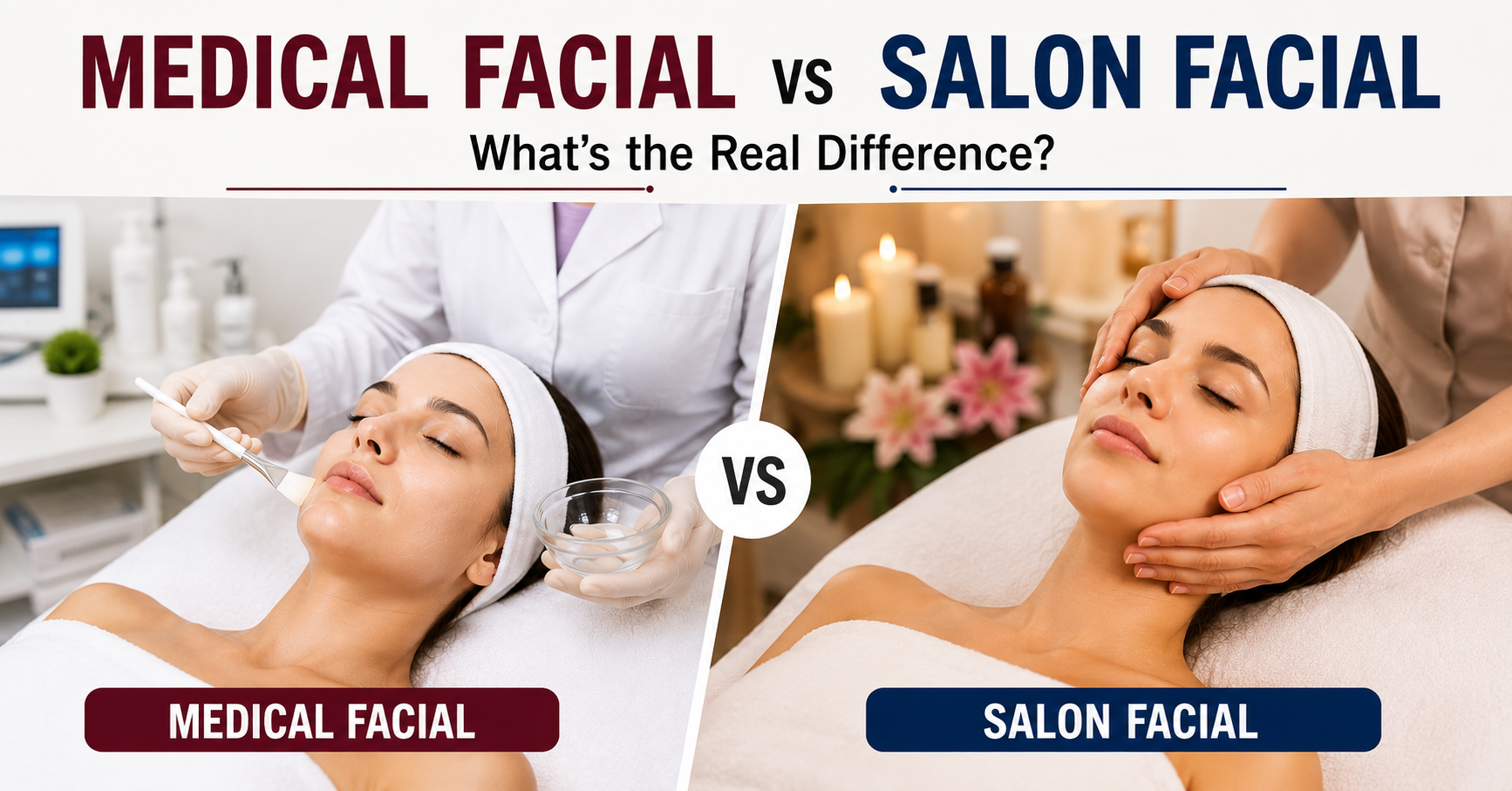
Walk into any salon today, and you’ll find an extensive menu of facials promising glowing skin, deep cleansing, anti-ageing benefits, and instant radiance. At the same time, dermatology clinics offer medical facials that claim to improve skin health, target specific concerns, and deliver long-lasting results. With so many options available, one question that my patients frequently ask is:
“Doctor, what’s the difference between a medical facial and a salon facial? Aren’t they basically the same?”
The answer is no.
While both treatments aim to improve the appearance of your skin, they differ significantly in terms of purpose, products used, customization, safety, technology, and long-term benefits.
As a dermatologist, I often meet patients who have spent months—or even years—getting regular salon facials without seeing meaningful improvement in acne, pigmentation, dullness, or early signs of ageing. This isn’t because salon facials are ineffective; it’s because they are designed for a completely different purpose.
In this article, I’ll explain the real difference between a medical facial and a salon facial, who should choose which treatment, and how you can make the right decision based on your skin concerns.
A salon facial is primarily a cosmetic skincare treatment designed to cleanse, exfoliate, hydrate, and temporarily brighten the skin.
Most salon facials follow a standard sequence that includes:
The goal is simple—to make your skin look refreshed and glowing immediately after the session.
For someone with generally healthy skin who wants relaxation before an event or simply wishes to maintain basic skin hygiene, a salon facial can be a pleasant experience.
However, it’s important to understand that these treatments are generally not designed to diagnose or treat medical skin conditions.
A medical facial is a dermatologist-supervised treatment that focuses on improving the health and function of your skin—not just its appearance.
Unlike salon facials, medical facials are customized after evaluating factors such as:
Instead of following the same protocol for every patient, medical facials are tailored specifically to your skin.
Depending on your concerns, a medical facial may include:
Every step is selected based on what your skin actually needs.
| Feature | Medical Facial | Salon Facial |
|---|---|---|
| Supervision | Dermatologist or trained medical professional | Beautician or therapist |
| Purpose | Improve skin health | Temporary glow |
| Customization | Highly personalized | Usually standardized |
| Products | Medical-grade | Cosmetic-grade |
| Suitable for acne & pigmentation | Yes | Limited |
| Sensitive skin | Carefully managed | May cause irritation |
| Results | Long-term improvement | Short-term freshness |
| Safety | Medical protocols | Cosmetic protocols |
This is perhaps the most important distinction.
A salon facial primarily focuses on making your skin look better.
A medical facial focuses on making your skin healthier.
Healthy skin naturally appears brighter, smoother, and more youthful.
As dermatologists, our aim is not simply to provide a temporary glow but to improve your skin’s overall function and resilience.
One of the biggest misconceptions is believing that every person should receive the same facial.
In reality, no two skins are alike.
For example:
A person with acne requires ingredients that reduce inflammation.
Someone with rosacea requires calming treatments.
A patient with pigmentation needs brightening ingredients.
Dry skin requires barrier repair.
Sensitive skin requires minimal irritation.
Using the wrong products—even if they are expensive—can worsen your skin condition.
This is why skin assessment before treatment is so important.
Unfortunately, yes.
Many patients visit us after developing irritation following frequent salon facials.
Common issues include:
Procedures like excessive steaming, harsh exfoliation, aggressive extraction, or using unsuitable products can aggravate existing skin problems.
This doesn’t happen in every salon, but it highlights the importance of understanding your skin before choosing any treatment.
One of the greatest strengths of a medical facial is personalization.
At Derma Solutions, every patient undergoes a detailed skin assessment before treatment.
We evaluate:
Only after this assessment do we recommend the most suitable facial.
This individualized approach helps maximize results while minimizing complications.
Medical facials can be beneficial for people dealing with:
Rather than masking these concerns, medical facials aim to improve them gradually and safely.
Many anti-ageing salon facials promise to reduce wrinkles instantly.
In reality, no facial can permanently remove wrinkles overnight.
Medical facials, however, can support healthy collagen production, improve hydration, enhance skin texture, and complement other dermatologist-recommended anti-ageing treatments.
The result is healthier, stronger, and more youthful-looking skin over time.
Absolutely.
Salon facials are suitable if:
There is nothing wrong with salon facials when expectations are realistic.
The problem arises when people expect them to treat acne, pigmentation, melasma, or medical skin conditions.
Consider a medical facial if you have:
If your concern has been present for months or keeps recurring, it’s time to consult a dermatologist instead of experimenting with multiple cosmetic treatments.
Most medical facials are comfortable and require little to no downtime.
Some treatments may cause mild redness that settles within a few hours.
Since every facial is tailored to your skin type, unnecessary irritation is minimized.
Your dermatologist will also guide you on post-treatment skincare to ensure the best results.
The ideal frequency depends on your skin condition.
As a general guideline:
Remember, consistency matters more than frequency.
Yes.
Medical facials often complement treatments such as:
Your dermatologist will recommend the appropriate combination based on your skin goals.
Many people compare only the upfront cost.
Instead, ask yourself:
While medical facials may cost more than regular salon facials, they often provide greater long-term value by targeting underlying concerns rather than offering only temporary cosmetic improvement.
Fact: They are also excellent for maintaining healthy skin and preventing future concerns.
Fact: They have different goals, different products, and different levels of customization.
Fact: Most are comfortable and involve minimal downtime.
Fact: Healthy skin requires ongoing care, a consistent home routine, and professional guidance.
Healthy skin is not achieved through occasional treatments alone.
It is the result of understanding your skin, using the right products, protecting it from the sun, maintaining a healthy lifestyle, and choosing treatments that are appropriate for your unique needs.
If your goal is simply to relax and enjoy a temporary glow, a salon facial can be a pleasant option.
However, if you’re struggling with acne, pigmentation, dullness, sensitivity, or signs of ageing, I encourage you not to rely solely on cosmetic treatments. Seeking professional advice early can save you time, money, and frustration while helping you achieve healthier, long-lasting results.
Every person’s skin tells a different story. Rather than following trends or copying someone else’s skincare routine, choose treatments based on what your skin truly needs.
Yes. Medical facials can be customized to reduce oiliness, calm inflammation, unclog pores, and support acne management under the supervision of a dermatologist.
Some are, but sensitive skin requires careful product selection. If you have frequent redness, irritation, rosacea, or eczema, it’s best to consult a dermatologist before undergoing any facial.
Results vary depending on your skin condition and home skincare routine. Regular maintenance and dermatologist-recommended products help prolong the benefits.
Yes. Medical facials are often recommended before important occasions to improve hydration, skin texture, and overall radiance. Your dermatologist can advise the ideal timing based on your skin type.
Most medical facials involve minimal or no downtime. Some people may experience mild redness for a few hours, which usually settles quickly.
The best way is to have your skin evaluated by a qualified dermatologist. A professional assessment ensures you receive a treatment that is safe, personalized, and aligned with your skin goals.

Written by: Dr. Sandeep Mahapatra
Senior Dermatologist, Hair Transplant Surgeon & Founder – Derma Solutions Skin & Hair Clinic, Bangalore
Dr. Sandeep Mahapatra is a senior dermatologist and hair transplant surgeon in Bangalore with extensive experience in dermatology, aesthetic treatments and hair restoration. As the founder of Derma Solutions Skin and Hair Clinic – Marathahalli, Bangalore , he has successfully performed over 10,000 hair transplant procedures and regularly guides patients on safe, ethical, and natural-looking hair restoration.
Medically reviewed by: Dr. Sandeep Mahapatra
Senior Dermatologist & Hair Transplant Surgeon
Date Reviewed: 2026-06-17
This article has been medically reviewed by Dr. Sandeep Mahapatra to ensure that the information is clinically accurate, patient-friendly, and aligned with safe dermatological practices. The content is intended for educational purposes and should not replace a personal consultation with a qualified dermatologist.
This article has been medically reviewed by Dr. Sandeep Mahapatra to ensure that the information is clinically accurate, patient-friendly, and aligned with safe dermatological practices. The content is intended for educational purposes and should not replace a personal consultation with a qualified dermatologist.
American Academy of Dermatology (AAD) – https://www.aad.org
Mayo Clinic – https://www.mayoclinic.org
Cleveland Clinic – https://health.clevelandclinic.org
Harvard Health Publishing – https://www.health.harvard.edu/topics/skin-and-beauty
DermNet NZ – https://dermnetnz.org