
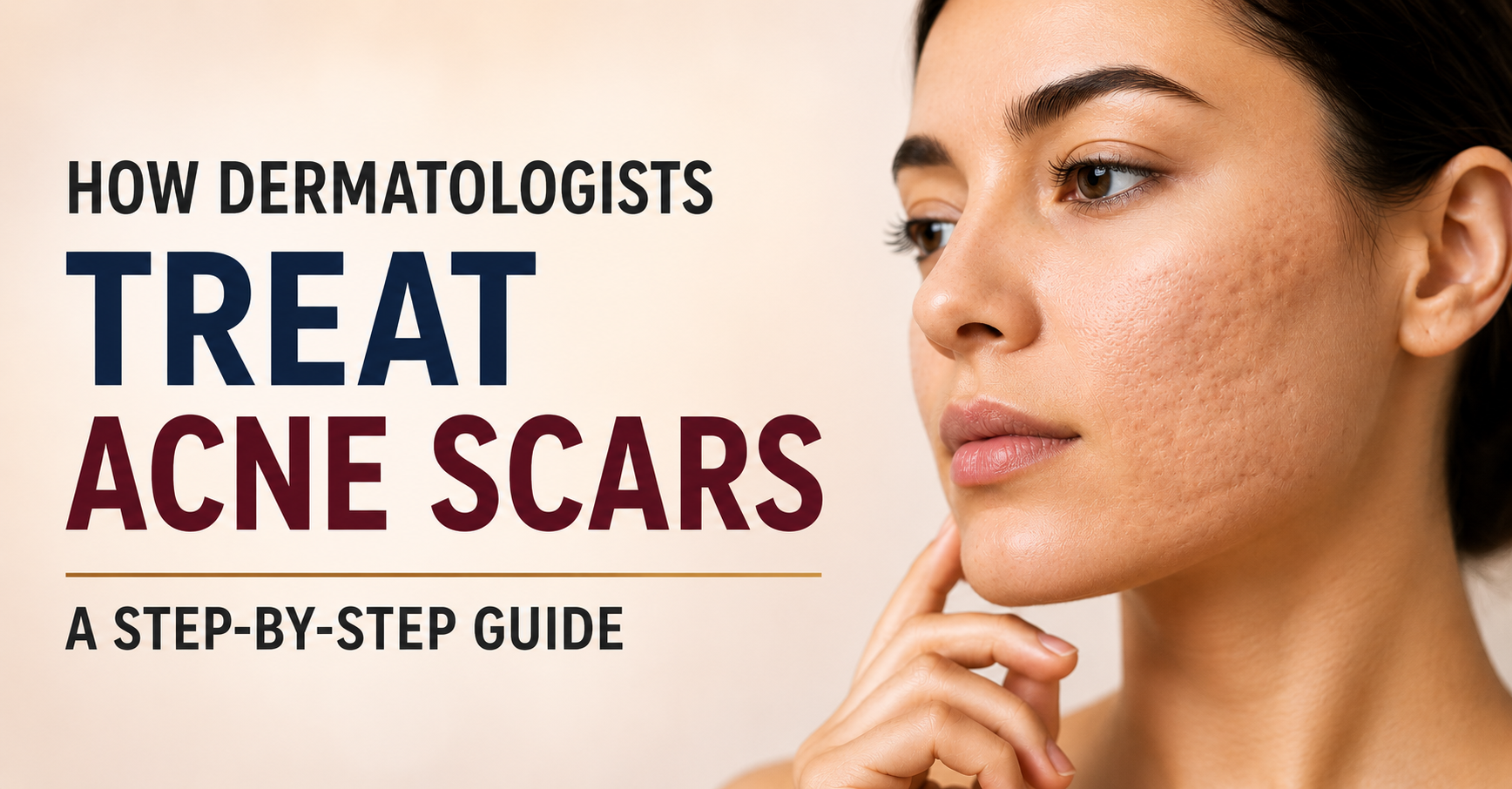
For many people, the most difficult part of acne begins after the acne has healed. While the pimples eventually disappear, they often leave behind permanent reminders in the form of acne scars. These scars can affect not only the appearance of the skin but also an individual’s confidence and self-esteem.
As a dermatologist, one of the most common concerns I hear from patients is, “Doctor, can my acne scars be completely removed?”
The answer depends on several factors. Acne scars can be significantly improved with modern dermatological treatments, but the right treatment varies from one patient to another. There is no single procedure that works for everyone because every scar is different.
Over the years, advancements in dermatology have given us several effective options to improve acne scars. The key lies in accurate diagnosis, individualized treatment planning, and choosing the right combination of procedures.
In this guide, I will take you through the step-by-step process of how dermatologists evaluate and treat acne scars, helping you understand what to expect from your treatment journey.
Before discussing treatments, it is important to understand why acne scars develop.
Acne scars occur when inflammation damages the deeper layers of the skin. During healing, the body attempts to repair the damaged tissue by producing collagen.
If too little collagen is produced, depressed or atrophic scars develop.
If too much collagen is produced, raised or hypertrophic scars may form.
Several factors increase the risk of acne scarring, including:
This is why early acne treatment is extremely important. Controlling acne before severe inflammation develops can significantly reduce the likelihood of permanent scarring.
Not all acne scars are the same.
One of the first things I do during consultation is carefully evaluate the type of scars present because treatment depends largely on the scar pattern.
The most common acne scars include:
These are narrow, deep scars that extend into the deeper layers of the skin.
Because they penetrate deeply, they are among the most challenging scars to treat.
These scars appear as wider depressions with well-defined edges.
They are commonly seen on the cheeks and temples.
Rolling scars create a wave-like appearance on the skin due to fibrous bands pulling the skin downward.
These scars often respond well to treatments that release these bands.
Unlike depressed scars, these scars appear raised because excess collagen is produced during healing.
Their treatment differs completely from that of atrophic scars.
Another important part of treatment planning is evaluating the patient’s skin type.
Indian skin generally falls under Fitzpatrick Skin Types IV and V.
These skin types contain higher amounts of melanin, making them more susceptible to:
This is why treatment settings and technologies must be carefully selected.
A procedure that works well for one patient may not be suitable for another.
Acne scars vary considerably in depth.
Some patients have:
Others have:
During consultation, I assess:
This detailed evaluation helps determine the most appropriate treatment strategy.
A common misconception is that scar treatment should begin immediately.
In reality, active acne should first be brought under control.
Treating scars while new pimples continue to develop increases the risk of additional scarring.
Depending on the severity, acne may first be treated using:
Only after acne is reasonably controlled do we begin scar correction.
This is where personalized care becomes essential.
Contrary to popular belief, there is no “best” acne scar treatment.
Instead, the best treatment depends on:
Many patients require combination therapy for optimal results.
One of the most effective procedures for rolling scars is subcision.
Rolling scars are tethered to deeper tissues by fibrous bands.
During subcision, a specialized needle is inserted beneath the skin to carefully release these bands.
Once released:
Subcision is often combined with other procedures such as MNRF or laser treatments for enhanced results.
Microneedling Radiofrequency has become one of my preferred treatments for many patients with acne scars.
This technology combines:
Tiny insulated needles deliver controlled radiofrequency energy into the deeper layers of the skin.
This stimulates:
Advantages of MNRF include:
Most patients require multiple sessions spaced four to six weeks apart.
Fractional CO₂ Laser is another highly effective treatment for acne scars.
Unlike MNRF, the laser resurfaces the skin by creating microscopic treatment zones while leaving surrounding tissue intact.
This stimulates:
Fractional CO₂ Laser is particularly useful for:
Because it affects the skin surface more extensively, downtime is longer than MNRF.
Ice pick scars often require a specialized technique called TCA CROSS (Chemical Reconstruction of Skin Scars).
During this procedure, a high concentration of trichloroacetic acid is applied directly into individual scars.
This stimulates controlled collagen formation inside the scar.
Over several sessions, the scars gradually become shallower.
TCA CROSS is frequently combined with other procedures to address mixed scar patterns.
Chemical peels may not remove deep acne scars, but they can improve:
Superficial and medium-depth peels are selected depending on the patient’s skin type and concerns.
Chemical peels are often incorporated into comprehensive acne scar treatment plans.
Platelet-Rich Plasma (PRP) has become an important adjunctive treatment in acne scar management.
PRP is prepared using the patient’s own blood. After processing, a concentrated layer rich in growth factors is obtained and injected or applied to the treated skin.
These growth factors help:
PRP is commonly combined with treatments such as Microneedling, MNRF, and Fractional CO₂ Laser to promote faster recovery and improve collagen remodeling.
Regenerative dermatology has introduced newer treatment options such as PDRN (Polydeoxyribonucleotide), often referred to as the Salmon DNA Facial.
Unlike treatments that simply improve skin hydration or resurface the skin, PDRN promotes tissue regeneration at a cellular level.
It helps:
While PDRN alone may not eliminate deep acne scars, it is an excellent complementary treatment that supports healing after procedures like lasers, microneedling, or MNRF.
Patients often notice healthier, brighter, and smoother skin as collagen remodeling progresses.
One of the biggest misconceptions about acne scar treatment is that a single procedure can treat every type of scar.
In reality, most patients have mixed acne scars, meaning different scar types exist on the same face.
For example, a patient may have:
Using only one treatment would leave many concerns unaddressed.
This is why I frequently recommend combination therapy.
A personalized treatment plan may include:
Each treatment addresses a different aspect of the scars, resulting in more comprehensive improvement.
Regardless of the treatment chosen, proper aftercare is essential for achieving the best results.
Patients are usually advised to:
Temporary redness, mild swelling, or peeling may occur depending on the procedure.
Most side effects settle naturally as the skin heals.
Good aftercare not only improves healing but also reduces the risk of pigmentation and other complications.
One question I hear almost every day is:
“Doctor, how many sessions will I need?”
The answer depends on:
In general:
Collagen remodeling is a gradual process.
Patients should understand that acne scar improvement develops over several months rather than overnight.
One of the most important parts of every consultation is discussing realistic outcomes.
No treatment can completely erase acne scars.
However, significant improvement is possible.
Depending on the type and severity of the scars, many patients achieve noticeable improvement in skin texture, smoother contours, and healthier-looking skin after completing a personalized treatment plan.
The goal is not perfection but meaningful, natural-looking improvement.
Throughout my practice, I have noticed several mistakes that can delay results or worsen acne scars.
Untreated acne increases the risk of permanent scarring.
Repeated squeezing damages the skin and increases inflammation.
Home remedies and social media hacks rarely improve acne scars and may even worsen pigmentation.
Collagen production requires time.
Patients should be patient and complete the recommended treatment course.
The cheapest option is not always the safest or the most effective.
The experience of the dermatologist and the suitability of the treatment matter far more.
Acne scars can have a lasting emotional and cosmetic impact, but they are no longer something patients simply have to live with.
Advances in dermatology have made it possible to significantly improve the appearance of scars using a range of safe and effective treatments.
The journey begins with a proper diagnosis, followed by a personalized treatment plan that addresses your unique skin concerns.
Whether your treatment involves MNRF, Fractional CO₂ Laser, Subcision, PRP, PDRN, Chemical Peels, TCA CROSS, or a combination of these procedures, patience and consistency are essential.
If you are considering acne scar treatment, remember that the most important decision is not choosing the latest technology—it is choosing an experienced MD Dermatologist who understands your skin and can recommend the right approach.
With the right guidance and evidence-based care, smoother, healthier, and more confident skin is an achievable goal.

Written by: Dr. Sandeep Mahapatra
Senior Dermatologist, Hair Transplant Surgeon & Founder – Derma Solutions Skin & Hair Clinic, Bangalore
Dr. Sandeep Mahapatra is a senior dermatologist and hair transplant surgeon in Bangalore with extensive experience in dermatology, aesthetic treatments and hair restoration. As the founder of Derma Solutions Skin and Hair Clinic – Marathahalli, Bangalore , he has successfully performed over 10,000 hair transplant procedures and regularly guides patients on safe, ethical, and natural-looking hair restoration.
Medically reviewed by: Dr. Sandeep Mahapatra
Senior Dermatologist & Hair Transplant Surgeon
Date Reviewed: 2026-06-17
This article has been medically reviewed by Dr. Sandeep Mahapatra to ensure that the information is clinically accurate, patient-friendly, and aligned with safe dermatological practices. The content is intended for educational purposes and should not replace a personal consultation with a qualified dermatologist.
This article has been medically reviewed by Dr. Sandeep Mahapatra to ensure that the information is clinically accurate, patient-friendly, and aligned with safe dermatological practices. The content is intended for educational purposes and should not replace a personal consultation with a qualified dermatologist.
American Academy of Dermatology (AAD) – Acne: Diagnosis and Treatment
https://www.aad.org/public/diseases/acne/derm-treat
American Society for Dermatologic Surgery (ASDS) – Laser Skin Resurfacing
https://www.asds.net/skin-experts/skin-treatments/laser-skin-resurfacing
British Association of Dermatologists (BAD) – Acne Patient Information Leaflet
https://www.skinhealthinfo.org.uk/condition/acne/
DermNet NZ – Acne Scarring
https://dermnetnz.org/topics/acne-scarring